


Friday, May 22, 2015
Control
Starring: Ray Liotta, Willem Dafoe, Michelle Rodriguez, Kathleen Robertson, Polly Walker, Stephen Rea


Friday, May 15, 2015
Shade
Starring: Stuart Townsend, Sylvester Stallone, Melanie Griffith, Jamie Foxx, Thandie Newton,
Gabriel Byrne, Roger Guenveur Smith, Bo Hopkins
Friday, May 08, 2015
Friday, May 01, 2015
Friday, April 24, 2015
Raising Helen
Starring: Kate Hudson, John Corbett, Joan Cusack, Hayden Panettiere, Spencer Breslin, Abigail Breslin, Helen Mirren, Felicity Huffman
Friday, April 17, 2015
Penelope
Starring: Christina Ricci, James McAvoy, Catherine O'Hara, Peter Dinklage, Richard E. Grant, Reese Witherspoon.
Friday, April 10, 2015
Friday, April 03, 2015
Friday, March 27, 2015
David Copperfield
Starring: Hugh Dancy, Sally Field, Michael Richards, Eileen Atkins, Anthony Andrews
Friday, March 20, 2015
The Count Of Monte Cristo
Starring: Jim Caviezel, Guy Pearce, Richard Harris, James Frain, Dagmara Dominczyk, Luis Guzmán
Friday, March 13, 2015
Friday, March 06, 2015
Friday, February 27, 2015
Friday, February 20, 2015
Friday, February 13, 2015
Wednesday, February 11, 2015
The Cost Of US Wars Since 9/11: $1.6 Trillion

Marine Infantry Officer Course students stand by before a helicopter drill in Arizona. US Marine Corps photo by Cpl. James Marchetti
The cost of US war-making in the 13 years since the September 11 terrorist attacks reached a whopping $1.6 trillion in 2014, according to a recent report by the Congressional Research Service (CRS).
The $1.6 trillion in war spending over that time span includes the cost of military operations, the training of security forces in Afghanistan and Iraq, weapons maintenance, base support, reconstruction, embassy maintenance, foreign aid, and veterans' medical care, as well as war-related intelligence operations not tracked by the Pentagon. The report tracks expenses through September, the end of the government's 2014 fiscal year.
The key factor determining the cost of war during a given period over the last 13 years has been the number of US troops deployed, according to the report. The number of troops in Afghanistan peaked in 2011, when 100,000 Americans were stationed there. The number of US armed forces in Iraq reached a high of about 170,000 in 2007.
Although Congress enacted across-the-board spending cuts in March 2013, the Pentagon's war-making money was left untouched. The minimal cuts, known as sequestration, came from the Defense Department's regular peacetime budget. The Pentagon gets a separate budget for fighting wars.
In the spending bill that Congress approved earlier this month, lawmakers doled out $73.7 billion for war-related activities in 2015—$2.3 billion more than President Barack Obama had requested. As Mother Jones' Dave Gilson reported last year, US military spending is on pace to taper far less dramatically in the wake of the Iraq and Afghanistan wars than it did after the end of the Vietnam War or the Cold War.
Other reports have estimated the cost of US wars since 9/11 to be far higher than $1.6 trillion. A report by Neta Crawford, a political science professor at Boston University, estimated the total cost of the wars in Iraq and Afghanistan—as well as post-2001 assistance to Pakistan—to be roughly $4.4 trillion. The CRS estimate is lower because it does not include additional costs including the lifetime price of health care for disabled veterans and interest on the national debt.
Chart by AJ Vicens.
Source: MotherJones
Tuesday, February 10, 2015
US: Terrorism Prosecutions Often An Illusion
The US Justice Department and the Federal Bureau of Investigation (FBI) have targeted American Muslims in abusive counterterrorism “sting operations” based on religious and ethnic identity, Human Rights Watch and Columbia Law School’s Human Rights Institute said in a report released today. Many of the more than 500 terrorism-related cases prosecuted in US federal courts since September 11, 2001, have alienated the very communities that can help prevent terrorist crimes.
The 214-page report, “Illusion of Justice: Human Rights Abuses in US Terrorism Prosecutions,”examines 27 federal terrorism cases from initiation of the investigations to sentencing and post-conviction conditions of confinement. It documents the significant human cost of certain counterterrorism practices, such as overly aggressive sting operations and unnecessarily restrictive conditions of confinement.
“Americans have been told that their government is keeping them safe by preventing and prosecuting terrorism inside the US,” said Andrea Prasow, deputy Washington director at Human Rights Watch and one of the authors of the report. “But take a closer look and you realize that many of these people would never have committed a crime if not for law enforcement encouraging, pressuring, and sometimes paying them to commit terrorist acts.”
The 214-page report, “Illusion of Justice: Human Rights Abuses in US Terrorism Prosecutions,”examines 27 federal terrorism cases from initiation of the investigations to sentencing and post-conviction conditions of confinement. It documents the significant human cost of certain counterterrorism practices, such as overly aggressive sting operations and unnecessarily restrictive conditions of confinement.
“Americans have been told that their government is keeping them safe by preventing and prosecuting terrorism inside the US,” said Andrea Prasow, deputy Washington director at Human Rights Watch and one of the authors of the report. “But take a closer look and you realize that many of these people would never have committed a crime if not for law enforcement encouraging, pressuring, and sometimes paying them to commit terrorist acts.”
Many prosecutions have properly targeted individuals engaged in planning or financing terror attacks, the groups found. But many others have targeted people who do not appear to have been involved in terrorist plotting or financing at the time the government began to investigate them. And many of the cases involve due process violations and abusive conditions of confinement that have resulted in excessively long prison sentences.
The report is based on more than 215 interviews with people charged with or convicted of terrorism-related crimes, members of their families and their communities, criminal defense attorneys, judges, current and former federal prosecutors, government officials, academics, and other experts.
In some cases the FBI may have created terrorists out of law-abiding individuals by suggesting the idea of taking terrorist action or encouraging the target to act. Multiple studies have found that nearly 50 percent of the federal counterterrorism convictions since September 11, 2001, resulted from informant-based cases. Almost 30 percent were sting operations in which the informant played an active role in the underlying plot.
In the case of the “Newburgh Four,” for example, who were accused of planning to blow up synagogues and attack a US military base, a judge said the government “came up with the crime, provided the means, and removed all relevant obstacles,” and had, in the process, made a terrorist out of a man “whose buffoonery is positively Shakespearean in scope.”
The FBI often targeted particularly vulnerable people, including those with intellectual and mental disabilities and the indigent. The government, often acting through informants, then actively developed the plot, persuading and sometimes pressuring the targets to participate, and provided the resources to carry it out.
“The US government should stop treating American Muslims as terrorists-in-waiting,” Prasow said. “The bar on entrapment in US law is so high that it’s almost impossible for a terrorism suspect to prove. Add that to law enforcement preying on the particularly vulnerable, such as those with mental or intellectual disabilities, and the very poor, and you have a recipe for rampant human rights abuses.”
Rezwan Ferdaus, for example, pled guilty to attempting to blow up a federal building and was sentenced to 17 years in prison. Although an FBI agent even told Ferdaus’ father that his son “obviously” had mental health problems, the FBI targeted him for a sting operation, sending an informant into Ferdaus’ mosque. Together, the FBI informant and Ferdaus devised a plan to attack the Pentagon and US Capitol, with the FBI providing fake weaponry and funding Ferdaus’ travel. Yet Ferdaus was mentally and physically deteriorating as the fake plot unfolded, suffering depression and seizures so bad his father quit his job to care for him.
The US has also made overly broad use of material support charges, punishing behavior that did not demonstrate an intent to support terrorism. The courts have accepted prosecutorial tactics that may violate fair trial rights, such as introducing evidence obtained by coercion, classified evidence that cannot be fairly contested, and inflammatory evidence about terrorism in which defendants played no part – and asserting government secrecy claims to limit challenges to surveillance warrants.
Ahmed Omar Abu Ali is a US citizen who alleged that he was whipped and threatened with amputation while detained without charge in Saudi Arabia – after a roundup following the 2003 bombings of Western compounds in the Saudi capital of Riyadh – until he provided a confession to Saudi interrogators that he says was false. Later, when Ali went to trial in Virginia, the judge rejected Ali’s claims of torture and admitted his confession into evidence. He was convicted of conspiracy, providing material support to terrorists, and conspiracy to assassinate the president. He received a life sentence, which he is serving in solitary confinement at the federal supermax prison in Florence, Colorado.
The US has in terrorism cases used harsh and at times abusive conditions of confinement, which often appear excessive in relation to the security risk posed. This includes prolonged solitary confinement and severe restrictions on communicating in pretrial detention, possibly impeding defendants’ ability to assist in their own defense and contributing to their decisions to plead guilty. Judges have imposed excessively lengthy sentences, and some prisoners suffer draconian conditions post-conviction, including prolonged solitary confinement and severe restrictions on contact with families or others, sometimes without explanation or recourse.
Nine months after his arrest on charges of material support for terrorism and while he was refusing a plea deal, Uzair Paracha was moved to a harsh regime of solitary confinement. Special Administrative Measures (SAMs) – national security restrictions on his contact with others – permitted Paracha to speak only to prison guards.
“You could spend days to weeks without uttering anything significant beyond ‘Please cut my lights,’ ‘Can I get a legal call/toilet paper/a razor,’ etc., or just thanking them for shutting our light,” he wrote to the report’s researchers. After he was convicted, the SAMs were modified to permit him to communicate with other inmates. “I faced the harshest part of the SAMs while I was innocent in the eyes of American law,” he wrote.
These abuses have had an adverse impact on American Muslim communities. The government’s tactics to seek out terrorism suspects, at times before the target has demonstrated any intention to use violence, has undercut parallel efforts to build relationships with American Muslim community leaders and groups that may be critical sources of information to prevent terrorist attacks.
In some communities, these practices have deterred interaction with law enforcement. Some Muslim community members said that fears of government surveillance and informant infiltration have meant they must watch what they say, to whom, and how often they attend services.
“Far from protecting Americans, including American Muslims, from the threat of terrorism, the policies documented in this report have diverted law enforcement from pursuing real threats,” Prasow said. “It is possible to protect people’s rights and also prosecute terrorists, which increases the chances of catching genuine criminals.”
Source: Human Rights Watch
Terrorist Plots Hatched By The F.B.I.
THE United States has been narrowly saved from lethal terrorist plots in recent years — or so it has seemed. A would-be suicide bomber was intercepted on his way to the Capitol; a scheme to bomb synagogues and shoot Stinger missiles at military aircraft was developed by men in Newburgh, N.Y.; and a fanciful idea to fly explosive-laden model planes into the Pentagon and the Capitol was hatched in Massachusetts.
But all these dramas were facilitated by the F.B.I., whose undercover agents and informers posed as terrorists offering a dummy missile, fake C-4 explosives, a disarmed suicide vest and rudimentary training. Suspects naïvely played their parts until they were arrested.
When an Oregon college student, Mohamed Osman Mohamud, thought of using a car bomb to attack a festive Christmas-tree lighting ceremony in Portland, the F.B.I. provided a van loaded with six 55-gallon drums of “inert material,” harmless blasting caps, a detonator cord and a gallon of diesel fuel to make the van smell flammable. An undercover F.B.I. agent even did the driving, with Mr. Mohamud in the passenger seat. To trigger the bomb the student punched a number into a cellphone and got no boom, only a bust.
This is legal, but is it legitimate? Without the F.B.I., would the culprits commit violence on their own? Is cultivating potential terrorists the best use of the manpower designed to find the real ones? Judging by their official answers, the F.B.I. and the Justice Department are sure of themselves — too sure, perhaps.
Carefully orchestrated sting operations usually hold up in court. Defendants invariably claim entrapment and almost always lose, because the law requires that they show no predisposition to commit the crime, even when induced by government agents. To underscore their predisposition, many suspects are “warned about the seriousness of their plots and given opportunities to back out,” said Dean Boyd, a Justice Department spokesman. But not always, recorded conversations show. Sometimes they are coaxed to continue.
Undercover operations, long practiced by the F.B.I., have become a mainstay of counterterrorism, and they have changed in response to the post-9/11 focus on prevention. “Prior to 9/11 it would be very unusual for the F.B.I. to present a crime opportunity that wasn’t in the scope of the activities that a person was already involved in,” said Mike German of the American Civil Liberties Union, a lawyer and former F.B.I. agent who infiltrated white supremacist groups. An alleged drug dealer would be set up to sell drugs to an undercover agent, an arms trafficker to sell weapons. That still happens routinely, but less so in counterterrorism, and for good reason.
“There isn’t a business of terrorism in the United States, thank God,” a former federal prosecutor, David Raskin, explained.
“You’re not going to be able to go to a street corner and find somebody who’s already blown something up,” he said. Therefore, the usual goal is not “to find somebody who’s already engaged in terrorism but find somebody who would jump at the opportunity if a real terrorist showed up in town.”
And that’s the gray area. Who is susceptible? Anyone who plays along with the agents, apparently. Once the snare is set, law enforcement sees no choice. “Ignoring such threats is not an option,” Mr. Boyd argued, “given the possibility that the suspect could act alone at any time or find someone else willing to help him.”
Typically, the stings initially target suspects for pure speech — comments to an informer outside a mosque, angry postings on Web sites, e-mails with radicals overseas — then woo them into relationships with informers, who are often convicted felons working in exchange for leniency, or with F.B.I. agents posing as members of Al Qaeda or other groups.
Some targets have previous involvement in more than idle talk: for example, Waad Ramadan Alwan, an Iraqi in Kentucky, whose fingerprints were found on an unexploded roadside bomb near Bayji, Iraq, and Raja Khan of Chicago, who had sent funds to an Al Qaeda leader in Pakistan.
But others seem ambivalent, incompetent and adrift, like hapless wannabes looking for a cause that the informer or undercover agent skillfully helps them find. Take the Stinger missile defendant James Cromitie, a low-level drug dealer with a criminal record that included no violence or hate crime, despite his rants against Jews. “He was searching for answers within his Islamic faith,” said his lawyer, Clinton W. Calhoun III, who has appealed his conviction. “And this informant, I think, twisted that search in a really pretty awful way, sort of misdirected Cromitie in his search and turned him towards violence.”
THE informer, Shahed Hussain, had been charged with fraud, but avoided prison and deportation by working undercover in another investigation. He was being paid by the F.B.I. to pose as a wealthy Pakistani with ties to Jaish-e-Mohammed, a terrorist group that Mr. Cromitie apparently had never heard of before they met by chance in the parking lot of a mosque.
“Brother, did you ever try to do anything for the cause of Islam?” Mr. Hussain asked at one point.
“O.K., brother,” Mr. Cromitie replied warily, “where you going with this, brother?”
Two days later, the informer told him, “Allah has more work for you to do,” and added, “Revelation is going to come in your dreams that you have to do this thing, O.K.?” About 15 minutes later, Mr. Hussain proposed the idea of using missiles, saying he could get them in a container from China. Mr. Cromitie laughed.
Reading hundreds of pages of transcripts of the recorded conversations is like looking at the inkblots of a Rorschach test. Patterns of willingness and hesitation overlap and merge. “I don’t want anyone to get hurt,” Mr. Cromitie said, and then explained that he meant women and children. “I don’t care if it’s a whole synagogue of men.” It took 11 months of meandering discussion and a promise of $250,000 to lead him, with three co-conspirators he recruited, to plant fake bombs at two Riverdale synagogues.
“Only the government could have made a ‘terrorist’ out of Mr. Cromitie, whose buffoonery is positively Shakespearean in its scope,” said Judge Colleen McMahon, sentencing him to 25 years. She branded it a “fantasy terror operation” but called his attempt “beyond despicable” and rejected his claim of entrapment.
The judge’s statement was unusual, but Mr. Cromitie’s characteristics were not. His incompetence and ambivalence could be found among other aspiring terrorists whose grandiose plans were nurtured by law enforcement. They included men who wanted to attack fuel lines at Kennedy International Airport; destroy the Sears Tower (now Willis Tower) in Chicago; carry out a suicide bombing near Tampa Bay, Fla., and bomb subways in New York and Washington. Of the 22 most frightening plans for attacks since 9/11 on American soil, 14 were developed in sting operations.
Another New York City subway plot, which recently went to trial, needed no help from government. Nor did a bombing attempt in Times Square, the abortive underwear bombing in a jetliner over Detroit, a planned attack on Fort Dix, N.J., and several smaller efforts. Some threats are real, others less so. In terrorism, it’s not easy to tell the difference.
Monday, February 09, 2015
Terrorism and The Other Religions
Contrary to what is alleged by bigots like Bill Maher, Muslims are not more violent than people of other religions. Murder rates in most of the Muslim world are very low compared to the United States.
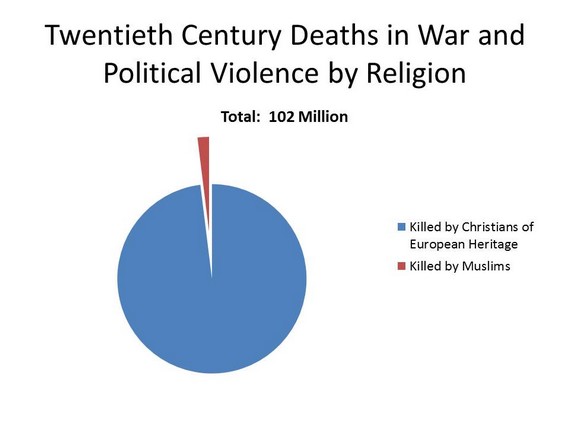
As for political violence, people of Christian heritage in the twentieth century polished off tens of millions of people in the two world wars and colonial repression. This massive carnage did not occur because European Christians are worse than or different from other human beings, but because they were the first to industrialize war and pursue a national model. Sometimes it is argued that they did not act in the name of religion but of nationalism. But, really, how naive. Religion and nationalism are closely intertwined. The British monarch is the head of the Church of England, and that still meant something in the first half of the twentieth century, at least. The Swedish church is a national church. Spain? Was it really unconnected to Catholicism? Did the Church and Francisco Franco’s feelings toward it play no role in the Civil War? And what’s sauce for the goose: much Muslim violence is driven by forms of modern nationalism, too.
I don’t figure that Muslims killed more than a 2 million people or so in political violence in the entire twentieth century, and that mainly in the Iran-Iraq War 1980-1988 and the Soviet and post-Soviet wars in Afghanistan, for which Europeans bear some blame.
Compare that to the Christian European tally of, oh, lets say 100 million (16 million in WW I, 60 million in WW II– though some of those were attributable to Buddhists in Asia– and millions more in colonial wars.)
Belgium– yes, the Belgium of strawberry beer and quaint Gravensteen castle– conquered the Congo and is estimated to have killed off half of its inhabitants over time, some 8 million people at least.
Or, between 1916-1930 Tsarist Russian and then Soviet forces — facing the revolt of Central Asians trying to throw off Christian (and then Marxist), European rule — Russian forces killed an estimated 1.5 million people. Two boys brought up in or born in one of those territories (Kyrgyzstan) just killed 4 people and wounded others critically. That is horrible, but no one, whether in Russia or in Europe or in North America has the slightest idea that Central Asians were mass-murdered during WW I and before and after, and looted of much of their wealth. Russia when it brutally conquered and ruled the Caucasus and Central Asia was an Eastern Orthodox, Christian empire (and seems to be reemerging as one!).
Then, between half a million and a million Algerians died in that country’s war of independence from France, 1954-1962, at a time when the population was only 11 million!
I could go on and on. Everywhere you dig in European colonialism in Afro-Asia, there are bodies. Lots of bodies.
Now that I think of it, maybe 100 million people killed by people of European Christian heritage in the twentieth century is an underestimate.
As for religious terrorism, that too is universal. Admittedly, some groups deploy terrorism as a tactic more at some times than others. Zionists in British Mandate Palestine were active terrorists in the 1940s, from a British point of view, and in the period 1965-1980, the FBI considered the Jewish Defense League among the most active US terrorist groups. (Members at one point plotted to assassinate Rep. Dareell Issa (R-CA) because of his Lebanese heritage.) Now that Jewish nationalsts are largely getting their way, terrorism has declined among them. But it would likely reemerge if they stopped getting their way. In fact, one of the arguments Israeli politicians give for allowing Israeli squatters to keep the Palestinian land in the West Bank that they have usurped is that attempting to move them back out would produce violence. I.e., the settlers not only actually terrorize the Palestinians, but they form a terrorism threat for Israel proper (as the late prime minister Yitzhak Rabin discovered).
Even more recently, it is difficult for me to see much of a difference between Tamerlan Tsarnaev and Baruch Goldstein, perpetrator of the Hebron massacre.
Or there was the cold-blooded bombing of the Ajmer shrine in India by Bhavesh Patel and a gang of Hindu nationalists. Chillingly, they were disturbed when a second bomb they had set did not go off, so that they did not wreak as much havoc as they would have liked. Ajmer is an ecumenical Sufi shrine also visited by Hindus, and these bigots wanted to stop such open-minded sharing of spiritual spaces because they hate Muslims.
Buddhists have committed a lot of terrorism and other violence as well. Many in the Zen orders in Japan supported militarism in the first half of the twentieth century, for which their leaders later apologized. And, you had Inoue Shiro’s assassination campaign in 1930s Japan. Nowadays militant Buddhist monks in Burma/ Myanmar are urging on an ethnic cleansing campaign against the Rohingya.
As for Christianity, the Lord’s Resistance Army in Uganda initiated hostilitiesthat displaced two million people. Although it is an African cult, it is Christian in origin and the result of Western Christian missionaries preaching in Africa. If Saudi Wahhabi preachers can be in part blamed for the Taliban, why do Christian missionaries skate when we consider the blowback from their pupils?
Despite the very large number of European Muslims, in 2007-2009 less than 1 percent of terrorist acts in that continent were committed by people from that community.
Terrorism is a tactic of extremists within each religion, and within secular religions of Marxism or nationalism. No religion, including Islam, preaches indiscriminate violence against innocents.
It takes a peculiar sort of blindness to see Christians of European heritage as “nice” and Muslims and inherently violent, given the twentieth century death toll I mentioned above. Human beings are human beings and the species is too young and too interconnected to have differentiated much from group to group. People resort to violence out of ambition or grievance, and the more powerful they are, the more violence they seem to commit. The good news is that the number of wars is declining over time, and World War II, the biggest charnel house in history, hasn’t been repeated.
By Juan Cole
Sunday, February 08, 2015
Comparing Israel To ISIS

"{ISIS'] quest for an ethnically pure Sunni state mirrors the quest for a Jewish state eventually carved out of Palestine in 1948. Its tactics are much like those of the Jewish guerrillas who used violence, terrorism, foreign fighters, clandestine arms shipments and foreign money, along with horrific ethnic cleansing and the massacre of hundreds of Arab civilians, to create Israel,"
[Chris Hedges]
Saturday, February 07, 2015
Sisi Plotted Army Rule Even While Mubarak Was In Power

Egypt’s new strongman drew up a blueprint for the army to seize power in case of a revolution against ex-president Hosni Mubarak as long ago as 2010, senior advisers have revealed.
The advisers have told The Telegraph he had already been identified by the army’s top brass before the 2011 revolution as its coming man, at a time when splits were growing between the military and the family of the 82-year-old Mr Mubarak.
In late 2010, when the then General Sisi was head of military intelligence, he was asked by his then bosses, who had already decided he should be the next minister of defence under any political settlement, to prepare a study of Egypt's political future.
He predicted that Mr Mubarak would try to pass on the country’s leadership to his son, Gamal, possibly as early as the following May, and that this could cause popular unrest. The report recommended the army should be prepared to move in to ensure stability - and preserve its own central role in the state.
As it turned out, events moved faster than anyone expected, with the uprising in Tunisia triggering street protests in Cairo in January 2011. Within a week, the army had enacted the plan Mr Sisi recommended, putting troops on the streets and saying it stood with the Egyptian people - making clear that Mr Mubarak and his sons were expendable, but the army was not.
Mr Mubarak was duly forced to resign on February 11.
The revelations about the army’s role at the time of his downfall are causing many of the revolutionaries to question whether the Tahrir Square protests brought down anything more than the figurehead of the old regime.
“When the revolution of January 25 exploded, the army already had plans to deploy,” said Hassan Nafaa, a prominent political scientist who was briefed personally on his report by the then General Sisi.
“I came to the conclusion that the army took advantage of the revolution to get rid of Mr Mubarak’s scheme of succession - maybe also that they had to sacrifice Mubarak, rather than the regime itself.”
Mr Sisi was seen as Mr Morsi’s choice because of his well-documented religious piety. No Brotherhood supporter could have risen so high in the army, but a thesis that Mr Sisi wrote in 2006 while on secondment to the US War College contained strongly Islamist themes, arguing that the ideal state was a pan-Islamic Caliphate, rather than a Western-style democracy.
Hassan Nafaa wondered whether Mr Sisi realised that the revolution had given people, particularly the young, a voice that they would not now give up. Mr Sisi would be mistaken if he thought that he could simply restore an unquestioned old-style regime.
“If he doesn’t take this into consideration, he isn’t convinced that Egypt has absolutely changed - that it will never be the same as it was before - he will fail,” said Mr Nafaa.
Subscribe to:
Posts (Atom)
