Tuesday, January 20, 2015

When Will Palestinians Learn?


Turning To International Law Isn't The Answer — Just Ask America and Israel


Throw an old dog a bone and sure enough, he’ll go chasing after it. So it is with “Palestine’s” request to join the International Criminal Court. An obvious attempt by Mahmoud Abbas to try Israel for war crimes in Gaza this year, we are told.
Or maybe a “two-edged sword” – yawns are permitted for such clichĂ©s – which could also put Hamas “in the dock”. Israel was outraged. The US was “strongly opposed” to such a dastardly request by the elderly potentate who thinks he rules a state which doesn’t even exist.
For years, the Palestinians have demanded justice. They went to the international court in The Hague to have Israel’s apartheid wall dismantled – they even won, and Israel didn’t give a hoot. 
Any sane Palestinian, you might think, would long ago have turned his or her back on such peaceful initiatives.
Yet still these wretched Palestinians persist, after this most humiliating of insults, in resorting to international law to resolve their conflict with Israel. Here they go again, dutifully seeking membership of the International Criminal Court. Will these Arabs never learn?
After all, the Palestinians would indeed have to abide by international law and – if the law applied retrospectively – they would have to carry the burden of opprobrium themselves for both Hamas crimes and past PLO murders. 
The United States, of course – and this fact oddly did not feature in the flurry of news reports on “Palestine’s” request to join – has itself refused to join the International Criminal Court. And with good reason; because, like the Israelis – although this is not quite how the whole fandango was explained to us – Washington is also worried that its soldiers and government officials will be arraigned for war crimes. Think waterboarding, Abu Ghraib, the report on CIA torture…
No wonder Jeffrey Rathke, the windbag who speaks for the State Department, says that the Palestinian request “badly damages the atmosphere” with Israel, “undermines trust” and “creates doubts about their (Palestinian) commitment to a negotiated peace”. 
And remember, Abbas only made his request after America had voted against – it has previously used its veto more than 40 times on Israel’s behalf to reject Palestine’s self-determination since 1975 – a UN Security Council resolution to end Israel’s occupation of Palestinian land by 2017.
The world is tired of witnessing the suffering of Palestinians. Those with an ounce of human sympathy are sickened at being slandered as anti-Semitic or anti-Zionist (whatever that is) every time they express their outrage at Israel’s cruelty towards the Palestinians.
Killing more than 2,000 Palestinians last summer, hundreds of them children, was a mass slaughter. We’ve watched this grotesquerie so many times now – in Gaza, for the most part – that even our statistics have become spattered with blood.
Who now recalls the fatalities of the 2008-9 Gaza war? One thousand four hundred and seventeen Palestinians dead, 313 of them children, more than 5,500 wounded. That was the conflict upon which President-elect Obama had no comment to make.
And who knows what other gory Pandora’s box ICC membership would open? That bomber pilot who in 2002 killed 15 civilians, 11 of them children, in a Gaza apartment block to assassinate a Hamas official, for example? Wouldn’t that constitute a war crime? Don’t these outrages “damage the atmosphere” and “undermine trust”. Were these bloodbaths not “entirely counterproductive”? And the Jewish colonisation of the occupied West Bank?
Sure, bang up those behind Hamas and Islamic Jihad suicide attacks for war crimes. Get the Palestinian Authority thugs who torture and murder their own prisoners. 
But that’s not what Israel and the US are worried about. They are concerned that, after months of arguing and rowing and delving through thousands of documents, jurists may decide that Israel – horror of horror – may have to answer for itself before international justice, something which no routine US veto could prevent.
Now just imagine if Israel and America wanted the Palestinians to sign the Rome document. Conjure the thought – for a split-second only – that Israel and America insisted that the Palestinians must abide by an international treaty and become members of the International Criminal Court to qualify for statehood. Abbas’s refusal to do so would be further proof of his “terrorist” intentions. Yet when Abbas does sign the Rome document, when the Palestinians want to abide by an international treaty, they must be punished – surely a “first” in modern history.

Monday, January 19, 2015

A Taboo On Telling The Truth About Palestine

Recently, while listening to a live performance of the Messiah, I remembered an article by John Pilger (right) which he adapted from his Edward Said Memorial Lecture presented in Adelaide, Australia, September 11.

The Adelaide lectures have been presented annually since 2005 in honor of the late Edward Said, the Palestinian scholar and political activist who was as a major face and voice of Palestine. 

I had been thinking about the absence of Christian outrage and action from the institutional Christian church over this summer’s Gaza massacre. Pilger, an Australian-born film-maker and author, who now lives in England, connected Said for me, to Psalm 2:3. He did so with a statement Pilger quotes from Said:
“There is a taboo,” said the visionary Edward Said, “on telling the truth about Palestine and the great destructive force behind Israel. Only when this truth is out can any of us be free.”
Handel chose Psalm 2:3 to deliver this same wisdom in Part Two of his Messiah: “Let us break their bonds asunder, and cast away their yokes from us.”

Our refusal to speak and act on the truth about Palestine’s physical and mental bondage imposed by the military might of Israel is a manifestation of our last taboo.

edward_saidWhat exactly is this taboo?

Said (left) believed the “great destructive force behind Israel” demands that we honor the taboo against telling the truth about Palestine.

During this Christmas season, what does the Christian church say and do, in its individual and corporate forms, about this bondage? 

We sing about angels in Bethlehem, and we thrill to the musicality of theHallelujah chorus that follows Psalm 2:3 in Handel’s Messiah.

We preach about loving our neighbor, but we say and do nothing to love our Palestinian neighbors enough to speak out and act against the Israeli occupation bondage which our nation defends, endorses and finances.
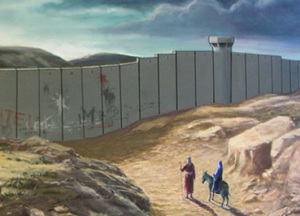
Bethlehem is not a stage setting for a fairy tale envisioned by Walt Disney. The birthplace of Jesus is a real city surrounded by a gigantic prison wall.

The birthplace of Jesus is a city held in bondage by the taboo against telling the truth about Palestine
This cannot continue. The time has come when the intimidation and fear must end. Pilger writes,
“For many people, the truth is out now. At last, they know. Those once intimidated into silence can’t look away now. Staring at them from their TV, laptop, phone, is proof of the barbarism of the Israeli state and the great destructive force of its mentor and provider, the United States, the cowardice of European governments, and the collusion of others, such as Canada and Australia, in this epic crime.”
Pilger reminds us that Nelson Mandela called the struggle of Palestine “the greatest moral issue of our time”
.
Pilger denounces the “mass murder” in Gaza this past summer, as an act “sponsored by the same godfather in Washington that answered the cries of children in Gaza with more ammunition to kill them”.

The psalmist instructs us that we will remain in bondage to an “epic crime” so long as continue to honor the taboo against telling the truth about Palestine.

Television writers remind us in sci-fi films, “the truth is out there”. True enough, but the psalmist reminds us that the truth of our bondage is part of our daily existence, a bondage that keeps us from smashing down those taboos that keep us blind to the suffering that cries out to be heard.

It is that taboo which keeps us from seeing, as journalist Chris Hedges writes, that the current tangible force of evil that haunts us is a creature of our own making, the Islamic State of Iraq and Syria (ISIS).Hedges
ISIS is “our Frankenstein” Hedges (left), writes:
“The United States after a decade of war in Iraq pieced together its body parts. We jolted it into life. We bathed it in blood and trauma. And we gave it its intelligence. Its dark and vicious heart of vengeance and war is our heart. It kills as we kill. It tortures as we torture.
It carries out conquest as we carry out conquest. It is building a state driven by hatred for American occupation, a product of the death, horror and destruction we visited on the Middle East.
There is no taboo against speaking of ISIS.  The taboo related to ISIS is its connection to another American creation, the modern state of Israel.

Hedges opens a door into the darkness of our refusal to acknowledge our major role in Israel’s creation myth. He sees ISIS as an emulation of the modern state of Israel.
“ISIS now controls an area the size of Texas. It is erasing the borders established by French and British colonial powers through the 1916 Sykes-Picot Agreement. There is little we can do to stop it.
ISIS, ironically, is perhaps the only example of successful nation-building in the contemporary Middle East, despite the billions of dollars we have squandered in Iraq and Afghanistan.
Its quest for an ethnically pure Sunni state mirrors the quest for a Jewish state eventually carved out of Palestine in 1948.”
Why have we not seen the parallels between the creation of ISIS and the earlier creation of Israel?  The taboo against speaking the truth about Palestine is enforced by our mainstream media, our churches and our political leaders.

bethlehem-wall-2010cropped
The bondage of the people of Palestine and the attacks by Israel are not limited to Palestinians. As Pilger points out:
“The attack on Gaza was an attack on all of us. The siege of Gaza is a siege of all of us. The denial of justice to Palestinians is a symptom of much of humanity under siege and a warning that the threat of a new world war is growing by the day.”
Hedges, a former New York Times correspondent who was based in Jerusalem, makes the connection between the rise of ISIS and the creation of the modern state of Israel:
“[ISIS] tactics are much like those of the Jewish guerrillas who used violence, terrorism, foreign fighters, clandestine arms shipments and foreign money, along with horrific ethnic cleansing and the massacre of hundreds of Arab civilians, to create Israel.
Antagonistic ISIS and Israeli states, infected by religious fundamentalism, would be irreconcilable neighbors. This is a recipe for apocalyptic warfare. We provided the ingredients.”
We are complicit in the creation of the modern Middle East. By honoring the taboo described by Edward Said, we made and now sustain Israel, not as a democracy which it claims to be, but as a war machine designed to extend the American empire over the bodies of dead children in Gaza and the West Bank.
Palestine Is Still The Issue:


Article by James M. Wall

Sunday, January 18, 2015

US Army Calls For ‘Military Support’ Of Israeli Energy Grab


Photo: An Egyptian man looks at flames rising from a pipeline that delivers gas to Israel and Jordan after it was hit by an explosion some 40 kilometres (25 miles) west of the town of Al-Arish in the north of the Sinai peninsula, early on 10 November, 2011 (AFP)

US Military Strategists Are Contemplating The Threat Of War To Redraw The Middle East’s Energy Architecture Around Israel

A new report by the US Army War College’s Strategic Studies Institute emphasises the need for “US security and military support” to its key allies in the Eastern Mediterranean, particularly Israel, over access to recent vast discoveries of regional oil and gas.
The Army study, released earlier in December 2014, concludes that extensive US military involvement “may prove essential in managing possible future conflict” in case of “an eruption of natural resource conflict in the East Mediterranean,” due to huge gas discoveries in recent years.
Visible US engagement is also necessary to ward off the regional encroachment of “emerging powers and potential new peace brokers such as Russia - which already entertains a strong interest in East Mediterranean gas developments - and notably China.”

Fossil Fuel Bonanza In The Levant

Since 2000, the Levant basin - an area encompassing the offshore territories of Israel, Palestine, Cyprus, Turkey, Egypt, Syria, and Lebanon - has been estimated to hold as much as 1.7 bn barrels of oil and up to 122 trillion cubic feet (tcf) of natural gas. As much of the region’s potential resources remain undiscovered, geologists believe this could be just a third of the total quantities of fossil fuels in the Levant.
The new US Army report argues that these hydrocarbon discoveries are of “tremendous economic and geostrategic significance,” not just for its allies, but for the United States itself. Israel especially stands to “gain considerably from their newly discovered gas wealth” in terms of cost-effective energy for domestic consumption and revenues from gas exports.
But while the discoveries offer the prospect for closer regional cooperation, they also raise “the potential for conflict over these valuable resources.” The potential for resource conflicts over oil and gas relates directly to intractable border conflicts between Israel, the Palestinians, Lebanon and Syria, as well as the unresolved Cypriot question between Greece and Turkey. US interests are to minimise the risk of conflict between its core allies, while maximising their capacity to exploit these resources.
“Israel, Cyprus, and Turkey are key strategic US allies,” the report says. “Neighbouring Egypt, Syria and Lebanon play important roles from the European and US perspective, both as direct neighbours to Israel and the Palestinian Territories as well as because of their strategically important location as the geographic interconnection between Europe, North Africa, and the Middle East.”
The new US Army report is authored by Mohammed al-Katiri and Laura al-Katiri. Mohammed al-Katiri was previously research director at the UK Ministry of Defence’s (MoD) Advanced Research and Assessment Group (ARAG), but now heads up two private intelligence consultancies, MENA Insight and the Conflict Studies Research Centre  (CSRC), both of which provide services to government and commercial sectors, including the oil and gas industry.
The Strategic Studies Institute (SSI) which published the report, calls itself an Army “think factory” for “commanders and civilian leaders.” SSI uses independent analysis to help “develop policy recommendations” for the US Army on national security and to “influence policy debate” across the military.

Advancing Israel’s Energy Empire

The SSI report on the risk of Middle East resource conflicts notes that Israel’s massive offshore gas discoveries “have yet to translate into proven gas reserves,” but that it’s total of 9.48 tcf of proven and 30 tcf estimated reserves, positions Israel “ahead of all East Mediterranean countries in terms of gas reserves and resource prospectivity.”
The Army report also reveals that Syria could hold significant offshore oil and gas potential. In 2007, before the outbreak of hostilities, President Bashar al-Assad launched a first bidding round to secure investment into new exploration efforts, and another in 2012 that was cancelled due to deteriorating security conditions.
“Once the Syria conflict is resolved, prospects for Syrian offshore production - provided commercial resources are found - are high,” observes the report.  Potential oil and gas resources can be developed “relatively smoothly once the political situation allows for any new exploration efforts in its offshore territories.”
The report also mentions significant gas finds in the offshore territories of Lebanon and Palestine, including the Gaza Marine, which holds over 1 tcf – production of which has been “obstruction by Israel over concerns regarding the flow of revenues to Palestinian stakeholders.” But in addition to the Gaza Marine, “Palestinian offshore territories near Gaza are believed to hold substantial hydrocarbon potential,” whose total quantities are still unknown because a lack of exploration there:
“Both Israel and Cyprus are key US allies and pillars of US foreign policy in the region: Israel, with its long history of close political ties with the United States, historically has stood at the heart of American efforts to secure regional peace; while Cyprus forms the most eastern part of Europe and is an important strategic location for both US and British military interests.”

Regional War

The region faces four main potential arcs of conflict. Firstly, in Israel-Palestine, the US Army study warns that “the presence of valuable natural resources in disputed territory may further feed the conflict.”
Secondly, rival claims between Israel and Lebanon over maritime boundaries could “complicate” the development of regional offshore hydrocarbon resources and result in military confrontation.
Thirdly, that risk has, in turn, delayed efforts to define Cypriot-Israeli and Cypriot-Lebanese exclusive economic maritime zones.
Fourthly, in 2013 Israel granted oil exploration licenses in the Syrian-claimed Golan Heights, spelling “potential for another armed conflict between the two parties should substantial hydrocarbon resources be discovered.” According to a report to the UN Security Council in early December, Israel has been in regular contact with Syrian rebels, including Islamic State fighters, raising the question of Israel’s role in supporting anti-Assad extremists to cement its control of Golan’s potential fossil fuel resources.
The US Army study highlights a real risk that tensions across these flashpoints could escalate into a wider regional conflict:
“In the case of an armed conflict between Israel and Lebanon, the security of the wider Levant region could once again be at stake, with a possible escalation of the conflict into neighbouring Syria and the Palestinian Territories, as well as (with historical precedents) Jordan and Egypt. In combination, the pre-existing political problems in all of these countries – Syria destabilizing into de facto civil war, Egypt in the midst of political instability, the Palestinians and Lebanese lacking stable political cores – the potential for a new, escalating regional war is a threatening scenario indeed.”

War For Peace (For Gas)

To stave off this disturbing prospect, the US report recommends that Israel and other Levant gas hubs like Lebanon and Cyprus play a key role in exporting Eastern Mediterranean gas to their Arab neighbours, such as Egypt, Turkey and Jordan, given that Middle East demand for gas is projected to rise dramatically in coming decades.
Further, the report highlights the possibility of Israel piping gas to Turkey, where it can be exported to European markets, making Turkey a regional gas transhipment hub. This would allow both Turkey and Europe to wean off their Russian gas dependence, and integrate instead into a “peaceful” US-Israeli dominated regional energy architecture.
As has been confirmed by Quartet Middle East envoy Tony Blair’s energy advisor, Ariel Ezrahi, Gaza’s offshore gas resources are seen as a potential bridge to overcome popular Arab public opposition to gas deals with Israel. “Israeli as well as Palestinian offshore hydrocarbon resources could play a significant role in facilitating mutual trust and the willingness to cooperate,” the US Army study suggests, “including between Israel and a few of its other Arab neighbours, Jordan and Egypt.”
But ultimately this architecture cannot be installed without extensive US intervention of some kind. “US diplomatic and military support has a pivotal role to play in the East Mediterranean’s complex geopolitical landscape, and its importance will only grow as the value of the natural resources at stake increases,” concludes the Army report:
“US security and military support for its main allies in the case of an eruption of natural resource conflict in the East Mediterranean may prove essential in managing possible future conflict.”
Diplomatically, the US could play a significant role in mediating between the various parties to facilitate successful oil and gas development projects across the East Mediterranean, not just for “Israel’s sake,” but also to shore-up allies like Jordan and Egypt with “low-cost Israeli gas,” contributing to regional economic and thus political stability:
“US support - diplomatic and, where necessary, military - can form a potentially powerful element in the safeguarding of these long-term economic benefits, at little cost in relative terms.”
If regional tensions escalate though, the report warns that “the United States also holds an important military position that could have an impact in securing the East Mediterranean,” including “military training and equipment support” to defend Cyprus and Israel from attacks on “their energy infrastructure and gas developments.”
This Orwellian document thus reveals that in the name of maintaining regional peace, a new Great Game is at play. To counter Russian and Chinese influence while cementing influence over its Arab allies, US military strategists are contemplating the threat of war to redraw the Middle East’s energy architecture around Israel.
 - Nafeez Ahmed PhD, is an investigative journalist, international security scholar and bestselling author who tracks what he calls the 'crisis of civilization.' He is a winner of the Project Censored Award for Outstanding Investigative Journalism for his Guardian reporting on the intersection of global ecological, energy and economic crises with regional geopolitics and conflicts. He has also written for The Independent, Sydney Morning Herald, The Age, The Scotsman, Foreign Policy, The Atlantic, Quartz, Prospect, New Statesman, Le Monde diplomatique, New Internationalist. His work on the root causes and covert operations linked to international terrorism officially contributed to the 9/11 Commission and the 7/7 Coroner’s Inquest.
The views expressed in this article belong to the author and do not necessarily reflect the editorial policy of Middle East Eye.


Saturday, January 17, 2015

I Love Israel and I Apologize

Palestinian refugees leaving a village near Haifa, June 1948
Palestinian refugees leaving a village near Haifa, June 1948. Photo by Corbis

... at a meeting convened by Ayelet Shaked (Habayit Hayehudi), the most successful politician in Israel at present explained: 
“This election is between those who apologize and those who are proud ... those who are objective and those who are in favor of the State of Israel.”
Well, [Habayit Hayehudi chairman] Naftali Bennett, I apologize and I love Israel (of course not your Israel and not the present Israel); I’m objective and I’m in favor of (a just) State of Israel; I apologize and I’m proud.
You’re going to stop apologizing? Israel never even started doing so
If only it had apologized a long time ago. If only it would acknowledge its sins, if only it would accept moral responsibility for them.
It’s no shame to apologize – it’s far more embarrassing not to do so. Apologizing is a strength, not a weakness, and on the way to reconciliation (with the Palestinians) we have to stop at the first station – an apology. 
It’s true that in the elite unit of Bennett and Yinon Magal they don’t apologize for anything, not even for acts of murder, assassinations and abductions (the murder of Abu Jihad, for example, or the abduction of Sheikh Obeid). In the settlements they don’t apologize for anything either – not for the exploitation, not for the disinheritance and not for the theft.
As a rule, in Israel people don’t apologize for anything, not in the occupation nor on the road. Guilt feelings are an embarrassment, and apologizing is for those with no backbone. 
That’s why Bennett’s election slogan: “Stop Apologizing. Be Proud” will become so catchy and popular: the “apologizers” vs. “the proud,” the “objective ones” vs. “lovers of the country.” I’m proud to belong to the former group.
I would like to apologize, if that would be of any significance, to the entire Palestinian people, throughout the generations. For 1948, for 1967 and for everything that happened in their wake. An apology for 1948 would not have made the state that was established less just – it would have become more just. For the mass expulsion and for preventing the return, for the ethnic cleansing in several districts and for several acts of slaughter, which may be part of every war – we can and should apologize.
We can and should apologize for the fact that what happened in 1948 has never ended. That the spirit of 1948 has not passed, and continues to this very day in the State of Israel’s basic attitude toward the Palestinian inhabitants of the land, in its sense of ownership and superiority, in its aggressiveness and violence, in its ultranationalism and racism.
Nor has anything changed in the policy of dispossession: Take what you can – then as now, when the State of Israel is already a regional power. We should apologize for that. We should apologize for the innumerable dead killed for no reason, for the endless lies and deception. For tyranny in the territories and for apartheid. For trampling a nation’s dignity, for suffocating its freedom and for separating it and breaking it up into tiny nations. For erasing its heritage and disdaining its culture. For short-changing Israeli Arabs and for demonstrations of racism against them. For the “price tag” crimes and the Operation Protective Edge crimes. For all of them we should apologize.
Apologizing would not solve anything or atone for anything, but it could signal a genuine intention to turn a new leaf.
Apologizing would broadcast moral strength and self-confidence, which the country so badly lacks, convinced as it is that it can live forever on its sword, even if there is not a single historical precedent for that. For all these things (and more) Israel will have to apologize some day.
Anyone who believes that even if the reconciliation is delayed, it will eventually come, understands that it must include an apology. That’s how it was in South Africa and that’s how it will be in Israel, if it’s not too late.

Friday, January 16, 2015

Celebrity


Starring: Hank Azaria, Kenneth Branagh, Leonardo DiCaprio, Winona Ryder, Melanie Griffith
Famke Janssen, Joe Mantegna, Charlize Theron

The WolfMan


Starring: Benicio del Toro, Anthony Hopkins, Emily Blunt, Hugo Weaving

Oblivion


Starring: Tom Cruise, Morgan Freeman, Olga Kurylenko, Andrea Riseborough, Nikolaj Coster-Waldau, Melissa Leo

John Carter


Starring: Taylor Kitsch, Lynn Collins, Mark Strong, CiarĂ¡n Hinds, Dominic West, James Purefoy,
Willem Dafoe

The Expendables 3


Starring: Sylvester Stallone, Jason Statham, Antonio Banderas, Jet Li, Wesley Snipes, Dolph Lundgren, Kelsey Grammer, Randy Couture, Terry Crews, Mel Gibson, Harrison Ford, Arnold Schwarzenegger

Rabbi Admits Islam Is The Oldest Religion


"A common root, a common faith, a fundamental religion in which all men are born into... This fundamental faith is called: Islam."

"Islam is an ancient religion. Islam is the religion of Noah. Islam is the religion of Adam himself."