Showing posts with label RADAR. Show all posts

Sunday, January 13, 2013

Quantum Imaging Heralds Unjammable Aircraft Detection


Physicists Have Exploited The Quantum Properties Of Photons To Create The First Imaging System That Is Unjammable

Jamming radar signals is an increasingly sophisticated affair. There are various techniques such as drowning the radar frequency with noise or dropping chaff to create a false reflection. But the most advanced radar systems can get around these ruses.

So a more sophisticated idea is to intercept the radar signal and modify it in a way that gives false information about the target before sending it back. That’s much harder to outsmart.

But today, Mehul Malik and pals at the University of Rochester in New York state demonstrate a way to do it.

These guys base their technique on the quantum properties of photons and in particular on the fact that any attempt to measure a photon always destroys its quantum properties.

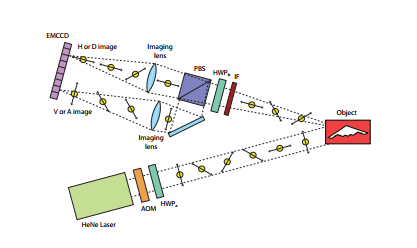
So their idea is to use polarised photons to detect and image objects. Reflected photons can of course be used to build up an image of the object. But an adversary could intercept these photons and resend them in a way that disguises the object’s shape or makes it look as if it is elsewhere.

However, such a process would always change the quantum properties of the photons such as their polarisation. And so it should always be possible to detect such interference. “In order to jam our imaging system, the object must disturb the delicate quantum state of the imaging photons, thus introducing statistical errors that reveal its activity,” say Malik and co.

That’s more or less exactly how quantum key distribution for cryptography works. The idea here is that any eavesdropper would change the quantum properties of the key and so reveal his or her presence. The only difference in the quantum imaging scenario is that the “message” is sent and received by the same person.

Malik and co have tested their idea by bouncing photons off an aeroplane-shaped target and measuring the polarisation error rate in the return signal. Without any eavesdropping the system easily imaged the aeroplane.

But when an adversary intercepted the photons and modified them to send back an image of a bird, the interference was easy to spot, say Malik and co.

That’s an impressive demonstration of the first imaging system that is unjammable thanks to quantum mechanics.

That’s not to say the technique is perfect. It suffers from the same limitations that plague early quantum cryptographic systems, which are theoretically secure but crackable in practice.

For example, instead of sending single photons, the quantum imaging system sends photon pulses which contain several photons. One or more of these can easily be siphoned away and analysed by an adversary without anybody else being any the wiser.

However, there are an increasingly wide range of fixes for these problems for quantum key distribution that could help make this quantum imaging system more secure.

Perhaps best of all, this kind of system could easily be put to work now. The techniques are well known and widely used in optics labs all over the world. So there’s no reason, this security cannot be added relatively quickly and cheaply to existing imaging systems.

Via: "Tehcnology Review"

Thursday, October 25, 2012

Boengs CHAMP Missile: Disables Computers As It Flies By


On October 16th, researchers from Boeing and the US Air Force successfully test-launched a missile capable of remotely disabling PCs and other electronics with only a burst of powerful radio waves. The test was held over the Western Utah Desert as part of the Counter-electronics High-powered Microwave Advanced Missile Project (CHAMP), a collaborative effort from Boeing Phantom Works and the US Air Force Research Laboratory Directed Energy Directorate. The project's aim is to create a missile that can remotely paralyze electronic systems with minimal collateral damage — a capability that, according to Boeing, could one day transform modern warfare.

During last week's test, a CHAMP missile successfully disabled its target by firing high power microwaves at a two story building filled with computers and other electronics. Every PC inside went dark within seconds, as did the building's entire electrical system. The test was so successful, in fact, that it even disabled all cameras recording the event. Over the course of one hour, the CHAMP missile knocked out electrical systems at seven target buildings, with little or no collateral damage.
Recent years have seen a surge in the development of similarly electronic and non-lethal warfare. Both the Air Force and US Marine Corps have been looking to adopt the Next Generation Jammer as well as active phased array radar, which allows stealth ships and aircraft to remotely jam other radar systems.
It remains unclear whether Boeing's CHAMP missile will see deployment anytime soon, though CHAMP program manager Keith Coleman says last week's test marks an important step forward. 
"This technology marks a new era in modern-day warfare," Coleman said. "In the near future, this technology may be used to render an enemy’s electronic and data systems useless even before the first troops or aircraft arrive." In proving the missile's ability, he continued, "we made science fiction science fact."

Tuesday, April 27, 2010

US Military Testing High-Tech Dirigibles In Utah


'Aerostats' Meant To Detect Cruise Missiles

By MIKE STARK
Source: AP News
Apr 15, 2010 04:42 EDT
Courtesy Of
Anti-War News

The skies over the Utah desert are becoming the test site for a new fleet of hulking high-tech dirigibles the U.S. military is hoping will provide battlefield commanders a bird's-eye view of cruise missiles and other threats.

One of the unmanned balloons — a 242-foot-long craft known as an aerostat — was launched Wednesday morning about 80 miles west of Salt Lake City. It stayed aloft for about three hours before it was pulled back down as planned.

It was the first several tests expected in the coming year or so in Utah, according to Paula Nicholson, a spokeswoman for Dugway Proving Ground. The next flights could be made later this week.

Vast tracts of military-owned desert were chosen for the testing because of their remoteness and resemblance to the mountainous, arid environment of Afghanistan, the military said in a statement.

The dirigibles are outfitted with radar and communications systems to provide long-range surveillance targeting threats from aircraft, ballistic and cruise missiles.

Waltham, Mass.-based Raytheon Co. was awarded a $1.4 billion contract from the Army in 2007 to design, build and test the aerostats.

Several more tests are proposed for Utah later in the year, including over the remote northern portion of the Great Salt Lake and parts of the Snake Valley.

The aerostats were first flight-tested in Elizabeth City, N.C., last summer but were limited to a height of 3,000 feet. In Utah, the dirigibles are expected to fly some 10,000 feet above the U.S. Air Force's Utah Test and Training Range, where air space is restricted up to 58,000 feet, the military said. The dirigibles are tethered to processing stations on the ground, and each is capable of staying aloft for a month.

They don't need an airstrip to launch and could even be tethered to ships at sea.

Officials said the aerostats will be less expensive to maintain and operate than conventional aircraft-based radar while providing battlefield commanders a bird's-eye view of threats in a given area.

"Not only will it expand the view well over the horizon, but do so at the least cost to the taxpayer. This is a critically needed capability as we continue to prosecute the global war on terrorism," Col. William E. King IV, Dugway's commander, said in a statement.

The program is known formally as the Joint Land Attack Cruise Missile Defense Elevated Netted Sensor System, or JLENS.

Source: AP News