


Physicists Have Exploited The Quantum Properties Of Photons To Create The First Imaging System That Is Unjammable
Jamming radar signals is an increasingly sophisticated affair. There are various techniques such as drowning the radar frequency with noise or dropping chaff to create a false reflection. But the most advanced radar systems can get around these ruses.
So a more sophisticated idea is to intercept the radar signal and modify it in a way that gives false information about the target before sending it back. That’s much harder to outsmart.
But today, Mehul Malik and pals at the University of Rochester in New York state demonstrate a way to do it.
These guys base their technique on the quantum properties of photons and in particular on the fact that any attempt to measure a photon always destroys its quantum properties.
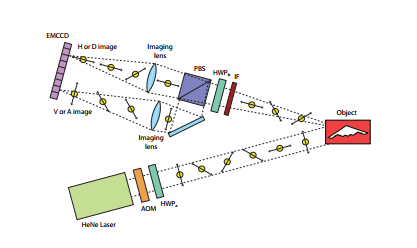
So their idea is to use polarised photons to detect and image objects. Reflected photons can of course be used to build up an image of the object. But an adversary could intercept these photons and resend them in a way that disguises the object’s shape or makes it look as if it is elsewhere.
However, such a process would always change the quantum properties of the photons such as their polarisation. And so it should always be possible to detect such interference. “In order to jam our imaging system, the object must disturb the delicate quantum state of the imaging photons, thus introducing statistical errors that reveal its activity,” say Malik and co.
That’s more or less exactly how quantum key distribution for cryptography works. The idea here is that any eavesdropper would change the quantum properties of the key and so reveal his or her presence. The only difference in the quantum imaging scenario is that the “message” is sent and received by the same person.
Malik and co have tested their idea by bouncing photons off an aeroplane-shaped target and measuring the polarisation error rate in the return signal. Without any eavesdropping the system easily imaged the aeroplane.
But when an adversary intercepted the photons and modified them to send back an image of a bird, the interference was easy to spot, say Malik and co.
That’s an impressive demonstration of the first imaging system that is unjammable thanks to quantum mechanics.
That’s not to say the technique is perfect. It suffers from the same limitations that plague early quantum cryptographic systems, which are theoretically secure but crackable in practice.
For example, instead of sending single photons, the quantum imaging system sends photon pulses which contain several photons. One or more of these can easily be siphoned away and analysed by an adversary without anybody else being any the wiser.
However, there are an increasingly wide range of fixes for these problems for quantum key distribution that could help make this quantum imaging system more secure.
Perhaps best of all, this kind of system could easily be put to work now. The techniques are well known and widely used in optics labs all over the world. So there’s no reason, this security cannot be added relatively quickly and cheaply to existing imaging systems.
Via: "Tehcnology Review"


