This is the point from which I could never return,
And if I back down now then forever I burn.
This is the point from which I could never retreat,
Cause If I turn back now there can never be peace.
This is the point from which I will die and succeed,
Living the struggle, I know I'm alive when I bleed.
From now on it can never be the same as before,
Cause the place I'm from doesn't exist anymore
[Immortal Technique]
"Terrorist"
"Terrorist"
Just a Word...
'Terrorist' is just a word, one I wish I'd never heard...
When it's used to vilify, without the need to question why...
Only fools would swift condemn, that which has not befallen them...
Until you know what lies behind, the actions of a tortured mind...
Thank your God for sparing you, the suffering others have lived through...
Where are the cries of just demand, for Arabs driven from their land?...
Blame the victim, turn the cheek, praise the bully, kick the weak!...
Mock the man who truth does speak...
Tinker, tailor, soldier, spy, greed, corruption, torture, lies!...
Blair invasion, sly persuasion, annihilation, massacred nation...
Keep on running, karma's coming!...
Money talks, truth walks, oil spills, greed kills...
Tide is turning, London's burning!...
Bombs will fall and blood will flow, as sure as my own name I know...
Until corrupt dictators go, brutal, rotten, to the core...
Their day has come, they rule no more...
Show me the man who will not fight, to save his child, his home, his right!...
You can call him what you like, you're not in his sorry plight...
Cowards stay and Martyrs go, I know not where, but this I know...
Speak your truth and stand your ground, fight your corner...
When all around, point the finger, purse the lips, pin the label, 'Terrorist'!...
Just a word, but one that sticks, even when the cap don't fit...
But for the grace of God go I, remember that, before you cry...
False accusation, names of shame, at those who may not be to blame,...
Their crime, refused to play the game, of meek acceptance, dumbing down,...
Your life, your choice; Warrior / Clown...
We’ve already seen the first wave of this technology in Disney’s amazingmulti-touch houseplants. Now, it’s being turned to humans. Whenever a user touches a display or object of any sort, theirCapacitive Fingerprintingtechnique fires electrical frequencies through that user’s body. And by analyzing the exact impedance--the frequencies’ interaction with the particular biochemical makeup of your body--the system can identify you and whomever else is around you tapping at the screen, too.
In fact, the ID technology is so hypersensitive, it won’t even recognize your body’s state eight hours later. “It is not that it is too sensitive, but that the condition and electrical properties of the human body change with time and location,” Poupyrev tells Co.Design. “So, at this point we’re investigating its use for short-term interaction that happens in simple games or in location-based entertainment.”
Indeed, Capacitive Fingerprinting is almost most exciting when it’s connected to devices that aren’t normally as omniscient as smartphones and tablets, but the countless slew of absolutely perfect objects--the tables and the doorknobs--that our world has labeled “dumb.” Or as Pouprev puts it a bit more poetically: “A physical, inanimate object can ‘feel’ who is touching. So, it is kind of magical.”
“In the human-computer interaction community, the general notion we’re working under is reality-based interfaces,” says Dr. Robert Jacob, a Tufts University computer science professor studying brain-computer interfaces. “We’re trying to design what is intuitive in the real world directly into our interaction with computers.”
He says intuitive interaction is apparent with the flowering of smart devices: squeezing the thumb and pointer finger together on a touchscreen to zoom in and spreading them out to zoom out, along with various augmented reality apps.
But such newfound intuitive functionality, amazing as it is, is just the beginning of what’s possible, says Chris Harrison,a doctoral candidate at Carnegie Mellon’s Human-Computer Interaction Institute.
“Imagine if the only thing you could use in the real world to operate things were a touch or a swipe,” says Harrison. “The world would be completely unusable. We knock. We scratch. We rub. We open bottles and we move things around. How do we bring that type of richness to the interface?”
Harrison’s work focuses on extending mobile interaction and input technologies. He worked on a project called TapSense, which allows a touchscreen to recognize the difference between a user’s knuckle, fingertip, pad and nail, and to use each type of contact to perform a different function.
“The next obvious thing that we’ll see with human-computer interaction is a move beyond multitouch,” Harrison says. “We won’t come to terms with the small space to use on phones and we’ll move to projectors.”
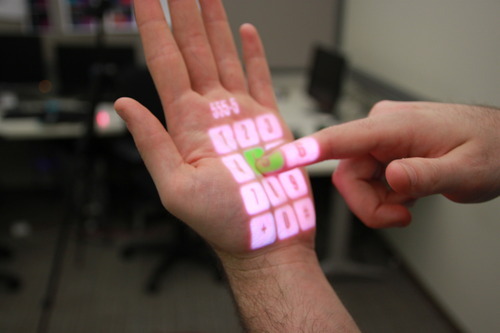
His idea is to break free from the constraints of the display screen altogether. He’s been busy turning such an idea into reality with a project called OmniTouch, which is a portable device that projects interactive graphics out onto a wall, table or the user’s body. The projection is meant to serve as an extension of a multitouch smart device.
Several products available or under development from others also demonstrate that using a finger or two to touch a tiny mobile screen isn’t the pinnacle of human input technology. They show that a fuller use of hand gesturing, a jump away from physical contact with the computer and employment of the space around a user are definitively in the offing for the next generation of human-computer interaction.
One information visualization company, Oblong, has developed what it calls a spatial operating environment, which fans of Minority Report should recognize.
Another, Leap Motion, has created a $70 device that interprets a user’s gestures within an eight-cubic-foot space, allowing the person’s movements to interact with the computer without touching it.
And researchers are working on different ways to glean input data, from Microsoft Kinect’s infrared laser depth finder and audio recognition software to a research project called SoundWave, which generates inaudible tones and uses the Doppler effect to sense gestures.
But not all of the work to make interactions with computers easier involves intentional actions or body movements. In fact, Jacob’s research at Tufts University is seeking to create interaction with a computer without the user knowing it.
His research focuses on lowering the cognitive demand of interacting with computers. His team is measuring blood flow changes in the brain to detect when a computer user is overloaded with work.
“When the brain does something hard, it sends out a request to the body that says, “Hey, I need more blood up here,’” Jacob says. “We shine a light into a person’s head and a sensor measures how much comes back out. That data can be used as real-time input to direct a person’s interaction with a computer.”
He says a computer can use the information from this technique, called functional near infrared spectroscopy, to adapt the user’s interface and manage workload. Imagine this: A pilot is given a fleet of five unmanned aerial vehicles to fly at once. Using the device, called Brainput, and a “heavy dose of machine learning,” he says, the computer would be able to understand when the pilot is working too hard to fly the fleet and transfer control of one or two of the vehicles to another person automatically. While the pilot is doing something less demanding, like flying the UAVs in a straight line to a destination, he could operate more of them.
“We’re coming at it as human interaction designers and asking how can you make a good interface without actively inputting data into the computer,” Jacobs says.
While human-computer interaction is still in its early stages, there are several input technologies that are developing—hand and body gesturing, natural language parsing, eye movement tracking and machine learning to give devices context awareness.
Carnegie Mellon’s Harrison sees the development of these technologies as complementary and, ultimately, synergistic.
“Pulling all this rich sensing and input together, it’ll sort of feel like AI [artificial intelligence],” he says. “There are a lot of pieces that need to come together, but it will be here in our lifetime.”
Top Image: An interface projected onto the user’s hand by OmniTouch, a novel wearable system that enables graphical, interactive, multitouch input on arbitrary, everyday surfaces. Photo courtesy Chris Harrison.