Showing posts with label Area 51. Show all posts

Saturday, December 07, 2013

Area 51 Hosted Tests For 'Secretly Acquired' Soviet Jets

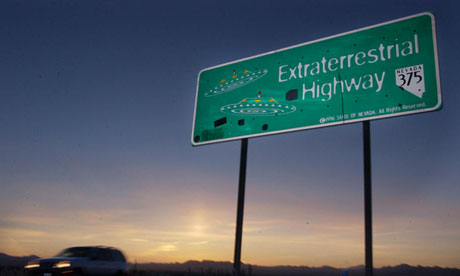
Area 51 highway
The Extraterrestrial Highway, or State Route 375, near the restricted land surrounding Area 51. The CIA in August confirmed the base's existence. Photo: Laura Rauch/AP

The US government “secretly acquired” Soviet aircraft during the Cold War and tested them at Area 51, according to documents released Tuesday that shed light on the once-classified and long speculated base deep in the Nevada desert.
The CIA in August confirmed the existence of Area 51 when it released declassified documents through a Freedom of Information Act request by George Washington University's National Security Archive. The initial documents show that Area 51 was used to test the US government’s aerial programs. 
One of those programs was the government’s investigation of the multiple Soviet MiG fighter planes it “secretly acquired” during the Cold War. The first documented acquisition was the MiG-21, originally obtained by Israel in August 1966. From January 1968 to April 1968, Israel loaned the plane to the US air force, which referred to the aircraft as the YF-110.
The air force examined the plane’s technical characteristics and evaluated its performance to see how the US government’s weapons and aircraft compared tactically under the Have Doughnut program (pdf). Similar evaluations were conducted in 1969 with the MiG-17 under the not-as-delightfully-named Have Drill and Have Ferry campaigns (pdf). Other MiG examinations took place later, but details of those programs have not been declassified.
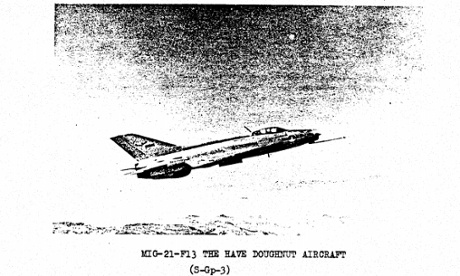
Area 51 HAVE DOUGHNUT program
Screenshot of declassified government document obtained through a FOIA request by George Washington University's National Security Archive.
As part of the air force’s evaluation of Soviet air scheme, the military group would simulate a Soviet-style air defense complex made out of systems with names including Mary, Susan and Kathy.
According to the documents (pdf), officials were concerned about maintaining secrecy of the space early on and it was nearly uncovered by American astronauts taking routine overhead imagery. These images set off an internal discussion about how to prevent exposure of the site.
Robert Singel, National Reconnaissance Office deputy director, said in a 1974 letter (pdf) that releasing the photos to the public “would almost certainly provide strong stimulus for media questioning and the potential near-term revelation of the missions of the installation.” 
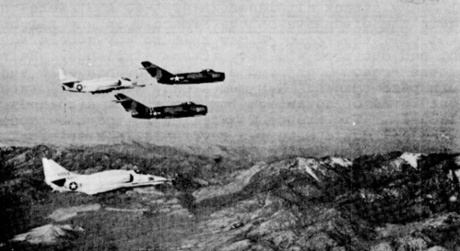
A-4F Skyhawk aircraft used in HAVE FERRY/HAVE DRILL
US Department of Defense determined that the A-4F Skyhawk (pictured) should not engage with the Soviet MiG-17 aircraft during the HAVE FERRY and HAVE DRILL evaluations. Photograph: Screenshot of declassified document obtained by the National Security Archive
The site was eventually transferred from the CIA to the air force in the late-1970s and became widely known in the mid-1990s.
Area 51 was discovered by government staffers and Lockheed Martin employees who thought it would be a good place to test aircraft while flying over Nevada, according to the first batch of documents.
Archive senior fellow Jeffrey T Richelson was able to review the documents in 2002, but mentions of Area 51 were redacted at the time. He submitted a request for the CIA’s history again in 2005 to continue his research on aerial surveillance programs.

Saturday, June 04, 2011

Inside Area 51

Exclusive: The Secret Birthplace Of The U2 Spy Plane

Published May 17, 2011
Courtesy Of "FOX News"


In her new book "AREA 51: An Uncensored History of America’s Top Secret Military Base," which goes on sale May 17, Annie Jacobsen offers for the first time an inside look at the history of America's top secret military base. It is the first book based on interviews with the scientist, pilots, and engineers -- 74 in total -- who for the first time reveal what really went on in the Nevada desert, from testing nuclear reactions to building super-secret supersonic jets to pursuing the war on terror.

Jacobsen, a contributing editor and investigative reporter at the Los Angeles Times Magazine, interviewed the former Area 51 employees in 2008 and 2009, shortly after the CIA declassified much of the work they had done, including countless pages of redacted memos and declassified reports. Area 51 is still officially a military secret, unmentioned by name, Jacobsen notes. 

In this exclusive excerpt, Jacobsen reveals some of the wild research that went on in the 1970s at Area 51 -- where the military built the U-2 spy plane, rather than harboring crashed UFOs.

Chapter 20: From Camera Bays To Weapons Bays

By 1974, the Central Intelligence Agency had ceded control of Area 51. Some insiders say the transition occurred in 1979, but since Area 51 does not officially exist, the Air Force won’t officially say when this handover occurred.

Certainly this had to have happened by the time the stealth bomber program was up and running; the F-117 program was the holy grail of Pentagon black projects — and, during that time period, the Air Force dominated Area 51.

Having no business in bombs, the CIA maintained a much smaller presence there than historically it had before. During the 1970s, the Agency’s work concentrated largely on pilotless aircraft, or drones. Hank Meierdierck, the man who wrote the manual for the U‑2 at Area 51, was in charge of one such CIA drone project, which began in late 1969.

Code-named Aquiline, the six-foot-long pilotless aircraft was disguised to look like an eagle or buzzard in flight. It carried a small television camera in its nose and photo equipment and air-sampling sensors under its wings. Some insiders say it had been designed to test for radiation in the air as well as to gather electronic intelligence, or ELINT. But Gene Poteat, the first CIA officer ever assigned to the National Reconnaissance Office, offers a different version of events. 

“Spy satellites flying over the Caspian Sea delivered us images of an oddly shaped, giant, multi-engine watercraft moving around down there on the surface. No one had any idea what this thing was for, but you can be sure the Agency wanted to find out."

"That is what the original purpose of Aquiline was for,” Poteat reveals. “To take close‑up pictures of the vehicle so we could discern what it was and what the Soviets might be thinking of using it for. Since we had no idea what it was, we made up a name for it."

"We called it the Caspian Sea Monster,” Poteat explains. Project Aquiline remains a classified project, but in September of 2008, BBC News magazine produced a story about a Cold War Soviet hydrofoil named Ekranopian, which is exactly what the CIA’s Aquiline drone was designed to spy on.

At Area 51, Hank Meierdierck selected his former hunting partner Jim Freedman to assist him on the Aquiline drone program. “It flew low and was meant to follow along communication lines in foreign countries and intercept messages,” Freedman says. “I believe the plan was to launch it from a submarine while it was waiting in port.” The Aquiline team consisted of three pilots trained to remotely control the bird, with Freedman offering operational support.

“Hank got the thing to fly,” Freedman recalls. Progress was slow and “it crash-landed a lot.” The program ended when the defense contractor, McDonnell Douglas, gave a bid for the job that Meierdierck felt was ninety-nine million dollars over budget. McDonnell Douglas would not budge on its bid, so Hank recommended that the CIA cancel Project Aquiline, which he said they did.

After the program was over, Hank Meierdierck managed to take a mock‑up of the Aquiline drone home with him from the area. “He had it sitting on his bar at his house down in Las Vegas,” Freedman recalls.

Project Aquiline was not the CIA’s first attempt to gather intelligence using cover from the animal kingdom. Project Ornithopter involved a birdlike drone designed to blend in with nature by flapping its wings. And a third, even smaller drone was designed to look like a crow and land on windowsills in order to photograph what was going on inside CIA-targeted rooms.

The tiniest drone program, orchestrated in the early 1970s, was Project Insectothopter, an insect-size aerial vehicle that looked like a dragonfly in flight. Insectothopter had an emerald green minifuselage and, like Ornithopter, flapped its wings, which were powered by a miniature engine that ran on a tiny amount of gas. Through its Office of Research and Development, or ORD, the CIA had also tried turning live birds and cats into spies.

In one such program, CIA-trained pigeons flew around Washington, DC, with bird-size cameras strapped to their necks. The project failed after the extra weight tired out the pigeons and they hobbled back to headquarters on foot instead of in flight. Another CIA endeavor, Acoustic Kitty, involved putting electronic listening devices in house cats.

But that project also backfired after too many cats strayed from their missions in search of food. One acoustic kitty got run over by a car. The Agency’s pilotless-vehicle projects were forever growing in ambition and in size. One robotic drone from the early 1970s, a project financed with DARPA, was disguised to look like an elephant —ready to do battle in the jungles of Vietnam.

Reprinted from the book AREA 51 by Annie Jacobsen. Copyright © 2011 by Annie Jacobsen. Reprinted with permission of Little, Brown and Company. All rights reserved.

ABOUT THE AUTHOR: ANNIE JACOBSEN is a contributing editor at the Los Angeles Times Magazine and an investigative reporter whose work has also appeared in the National Review and the Dallas Morning News. Her two-part series “The Road to Area 51” in the Los Angeles Times Magazine broke online reader records and remained the “most popular/most emailed” story for ten consecutive days. 

Learn more at the Area 51 website.