The Destabilization Of The Middle East and Central AsiaThe Mumbai Attacks and The “Strategy Of Tension”By Andrew G. MarshallDecember 7, 2008Courtesy Of Global ResearchIntroduction
The recent attacks in Mumbai, while largely blamed on Pakistan’s state-sponsored militant groups, represent the latest phase in a far more complex and long-term “strategy of tension” in the region; being employed by the Anglo-American-Israeli Axis to ultimately divide and conquer the Middle East and Central Asia. The aim is destabilization of the region, subversion and acquiescence of the region’s countries, and control of its economies, all in the name of preserving the West’s hegemony over the “Arc of Crisis.”
The attacks in India are not an isolated event, unrelated to growing tensions in the region. They are part of a processof unfolding chaos that threatens to engulf an entire region, stretching from the Horn of Africa to India: the “Arc of Crisis,” as it has been known in the past.
The motives and modus operandi of the attackers must be examined and questioned, and before quickly asserting blame to Pakistan, it is necessary to step back and review:
Who benefits? Who had the means? Who had to motive? In whose interest is it to destabilize the region? Ultimately, the roles of the United States, Israel and Great Britain must be submitted to closer scrutiny.
The Mumbai Attacks: 11/26/08
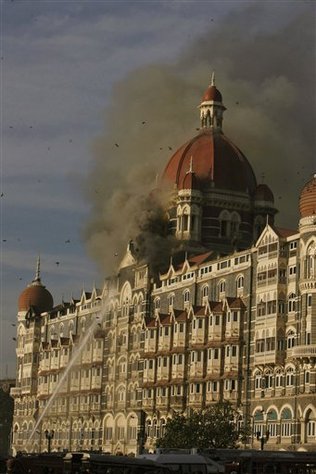
On November 26, 2008, a number of coordinated terrorist attacks occurred across India’s main commercial city of Mumbai, which lasted until November 29. The attacks and three-day siege that ensued left hundreds dead, and roughly 295 others injured. Among the dead were a Briton, five Americans and six Israelis.[1]
Asserting the Blame
The 60-hour siege that engulfed Mumbai was reportedly undertaken by just ten, well-trained “commando killers.” Most blame has fallen on the heels of the group known as Lashkar-e-Taiba.[2]
At first, a previously-unheard of organization, known as the Deccan Mujahideen, took responsibility for the terror attacks when it sent emails to several news outlets a mere six hours after the fighting began. However, much skepticism remained about whether the group actually even exists.[3]
British intelligence then claimed that the attacks had the “hallmarks” of Al-Qaeda as it was undertaken in an effort to target westerners, similar to the 2002 Bali Bombings. British intelligence officials suggested the attacks were in “retaliation” for the recent US air attacks of suspected Al-Qaeda camps in the Pakistan-Afghanistan border region, and that India was chosen as the target because that is where Al-Qaeda has “sufficient resources to carry out an attack.”[4]
On November 28, India’s foreign minister said the attackers were coordinated “outside the country,” in a veiled reference to Pakistan.[5] India’s Prime Minister also blamed the attacks on militant groups based in Pakistan, which are supported by the Pakistani government.[6]
Then, the focus was put directly on the group, the Lashkar-e-Taiba, a militant Pakistani-based organization responsible for past attacks in India. American intelligence early on pointed the finger at this group, as well as identifying the Pakistani ISI (Inter-Services Intelligence) as its supporter.[7]
The Lashkar-e Taiba (LeT)
It is important to identify what the LeT is and how it has operated historically. The group operates out of the disputed territories between India and Pakistan, Jammu and Kashmir. It has close ties with the Pakistani ISI, and is largely known for its use of suicide attacks. However, aside from its links to the ISI, it is also closely allied with the Taliban and Al-Qaeda. The LeT is even referred to as the “most visible manifestation” of Al-Qaeda in India. It has branches across much of India, Pakistan, and in Saudi Arabia, Bangladesh, South East Asia, and the United Kingdom. It primarily gets its funding from Pakistani businessmen, the ISI and Saudi Arabia. The LeT also took part in the Bosnian campaign against the Serbs in the 1990s.[8]
All the above-mentioned connections make the LeT the most desirable outfit to blame for the Mumbai attacks, as its Al-Qaeda connections, international presence and historical precedents of terror attacks set it up as the perfect target. Much like with Al-Qaeda, the LeT’s international scope could serve as a basis for taking a “war against LeT” to the steps of many countries, thus further serving the interests of the Anglo-American “War on Terror.”
Militant Islam and Western Intelligence – The Case of Yugoslavia
The LeT has not operated independently of Pakistani influence and finances. It’s close relationship with the ISI must be viewed in context: the ISI has a close relationship with Western intelligence agencies, primarily those of Great Britain and the United States. The ISI has effectively acted as a conduit for Anglo-American intelligence operations in the region since the late 1970s, when the Afghan Mujahedeen were created in collusion with the CIA. Out of this collusion, lasting throughout the 1980s until the end of the Soviet-Afghan War in 1989, Al-Qaeda was created, as well as a series of other militant Islamic organizations.
It is often stated that the CIA then discontinued its relationship with the ISI, and in turn, that the militant Islamic organizations broke off from their Western intelligence sponsors to declare war against the West. However, the facts do not support this. The ties remained, but the strategy changed. What changed was that in the early 1990s, the Cold War ended, and Russia no longer was the “Evil Empire,” and thus the excuse for an exacerbated defence budget and imperialist foreign policy receded. As George H.W. Bush declared, it was during this time that we would see the formation of the “New World Order.” And with that, there was a need for a new, elusive enemy, not in the form of a nation, but a seemingly invisible enemy, international in scale, thus taking the war to an international arena.
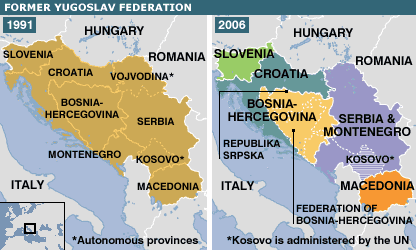
So in the early 1990s, Western intelligence maintained its ties to these Islamic terrorist groups. Yugoslavia is a very important case to analyze in relation to current events. The break-up of Yugoslavia was a process undertaken by Anglo-American covert interests with the aim of serving their imperial ambitions in the region. In the early 1980s, the IMF set the stage in Yugoslavia with its Structural Adjustment Programs, which had the effect of creating an economic crisis, which in turn created a political crisis. This exacerbated ethnic rivalries, and in 1991, the CIA supported the Croat move for independence.
In 1992, with the start of the Bosnian War, Al-Qaeda-affiliated terrorists began operating with the ethnic Bosnian Muslim minority in fighting the Serbs. In turn, these Al-Qaeda affiliated groups were supported with training, arming, and finances by German, Turkish, Iranian and US intelligence agencies; with additional financial support from Saudi Arabia. In 1997, the Kosovo War began, in which the militant-terrorist-drug trafficking Kosovo Liberation Army (KLA) began fighting against Serbia, with training, arms and financial support from the US and other NATO countries. The CIA, German intelligence, the DIA, MI6 and British Special Forces (SAS) all provided training and support to the KLA.
Yugoslavia - Before and After Balkanization
The aim was in breaking up Yugoslavia, using ethnic rivalries as the trigger for regional conflict and ultimately war, leading to the dissolution of Yugoslavia into several countries, justifying a permanent US and NATO military presence in the region. [See: Breaking Yugoslavia, by Andrew G. Marshall, Geopolitical Monitor, July 21, 2008]
The Lashkar-e Taiba’s participation in the Bosnian War against Serbia would have in turn been financed and supported by these various Western intelligence agencies, thus serving the interests of Western Imperialist states; primarily those of Great Britain and the United States.
The LeT and Western Intelligence
The LeT has a sordid history of involvement with Western intelligence agencies, primarily those of Great Britain.
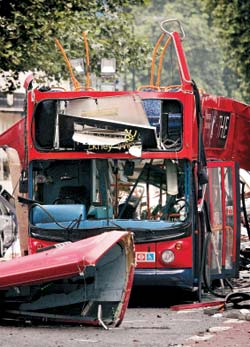
With the London 7/7 bombings [July 7, 2005] in which three underground stations and a double-decker bus had bombs explode on them; many of the suspected terrorists had interesting connections to Pakistan. For example, one of the suspects, Shehzad Tanweer, had apparently “attended a religious school run by the terrorist group Lashkar-e-Taiba (LeT)” while in Pakistan. Due to the LeT’s ties with Al-Qaeda, this allowed for the conclusion to be drawn that Al-Qaeda may have played a part in the London bombings, which were initially blamed on the international terrorist organization. The LeT also has close ties with the Jemaah Islamiyyah (JI),[9] an Indonesian terrorist organization, which was blamed for the 2002 Bali bombings, which also targeted tourists in Indonesia.
The Bali Bombings
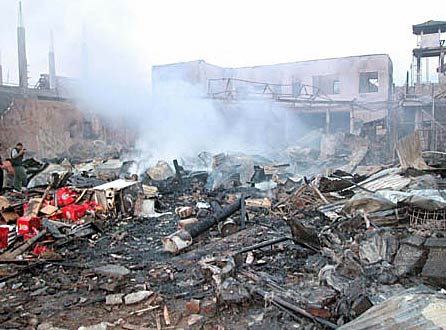
Interesting to note, however, is that in the early 1990’s, when the Jemaah Islamiyyah (JI) was officially formed into a terrorist organization, it developed close ties with Osama bin Laden and Al-Qaeda. Further, the organizations founders and leaders played a significant role in recruiting Muslims to join the Afghan Mujahideen in the war against the Soviets during the 1980’s, which was covertly directed and supported by US, British and various other Western intelligence agencies. The JI wouldn’t exist “without the CIA’s dirty operations in Afghanistan.” A former Indonesian President stated that one of JI’s key individuals was also a spy for the Indonesian intelligence agency, and that Indonesian intelligence played a more central role in the Bali bombings than the JI itself.
Bali Bombings
The JI itself, had reportedly been infiltrated by the CIA, Israeli Mossad, and that “the CIA and the Mossad, assisted by the Australian Special Action Police (SAP) and the M15 of England, are all working towards undermining Muslim organizations in an attempt to weaken the Muslims globally.” Further, one of JI’s key planners of the Bali bombings, Omar al-Faruq, was reportedly a CIA asset, and even senior Indonesian intelligence officials believed the CIA was behind the Bali bombings. The CIA subsequently “guided” Indonesia’s investigation into the bombings, which found the JI, and the JI alone, responsible for the attacks. [See: Andrew G. Marshall, The Bali Bombings. Geopolitical Monitor, November 15, 2008]
London 7/7
Much of the focus of the London bombings of July 7, 2005 (7/7), was focused on the “Pakistani connection.” The suspected bombers had all visited Pakistan, and apparently developed contacts with groups such as Jaish-e-Mohammed and the Lashkar-e Taiba. However, a less known and less publicized connection yields some very interesting information. The suspected mastermind of the London bombings, Haroon Rashid Aswat, had visited all the suspected bombers leading up to the attacks. Phone records revealed that there were “around 20 calls between him and the 7/7 gang, leading right up to those attacks.” Why is this significant? Because Haroon Rashid Aswat, apart from being an Al-Qaeda operative, also happened to be an MI6 agent, working for the British intelligence. Haroon also made his appearance on the scene of Islamic terrorism when he was in Kosovo in the 1990’s, where he “worked for British intelligence.”[10]
The Liquid Bomb Plot
Another event which brought to the forefront a “Pakistani connection” was the August 2006 London liquid bomb plot, in which terrorists supposedly were plotting to blow up nearly a dozen Atlantic airliners bound for major US cities.
The Pakistani ISI apparently helped in “uncovering” the liquid bomb plot, aiding the British in their roundup of suspects, and “tipped-off MI5.” One of the Pakistani groups accused of some involvement in the liquid bomb plot was the Lashkar-e Taiba.[11]
However, again, the suspected terrorists had been “infiltrated” and spied on by British intelligence for over a year. Further, the supposed ringleader of the bomb plot, Rashid Rauf, a dual British-Pakistani citizen, was pinpointed as the ringleader by both British and Pakistani intelligence, and was the link between the plot and Al-Qaeda. Rauf also has close ties with the ISI, and apparently had the plot approved by Al-Qaeda’s number two in command, Ayman al-Zawahiri, who formerly worked for the CIA during the Soviet-Afghan war. The ISI had arrested Rashid Rauf following the “exposure” of the liquid bomb plot, yet, in 2006, the charges against him were dropped, and in 2007, he amazingly escaped Pakistani custody, having “managed to open his handcuffs and evade two police guards.” [See: Andrew G. Marshall, Liquid Bomb Plot. Geopolitical Monitor: October 27, 2008]
Clearly, if the LeT is discovered to be responsible for the Mumbai attacks, its connections to Western intelligence agencies should be more closely examined and subject to investigation. The ISI, throughout its history, has not been the key player in supporting various terrorist organizations, rather, it can be more accurately described as a conduit for Western intelligence agencies to covertly fund and support terrorist organizations in the Middle East and Central Asia.
Terrorizing India
We must examine the current attacks with a backdrop of reviewing recent terror attacks in India.
1993 Bombay Bombings
March 12, 1993, Bombay (today, Mumbai) experienced a coordinated attack of 13 explosions, which killed over 250 people. A man with close connections to Osama bin laden and Al-Qaeda, Dawood Ibrahim, was believed to have been the mastermind of the attacks. He has also financed several operations of the Lashkar-e Taiba, and was believed to be hiding out in Pakistan, and receiving protection and support from the Pakistani ISI, which in 2007, reportedly arrested him. [See: Andrew G. Marshall, Political Destabilization in South and Central Asia: The Role of the CIA-ISI Terror Network. Global Research: September 17, 2008]
Mumbai Bombings, July 11, 2006: 7/11
Over 200 people were killed in Mumbai when seven bombs exploded within 11 minutes of one another on several trains. Blame for the attacks was placed with the Students Islamic Movement of India (SIMI) and the Lashkar-e Taiba (LeT), both of which have close ties with the ISI. The ISI was subsequently blamed for organizing the attacks, which were then carried out by the LeT and SIMI. The bombings led to the postponement of India-Pakistan peace talks, which were set to take place the next week. [Ibid]
Indian Embassy Bombing in Kabul, Afghanistan: July 7, 2008
On July 7, 2008, a bomb exploded at the Indian embassy in Kabul, Afghanistan, killing over 50 people, and injuring over 100 others. The Afghan government and the Indian intelligence agency immediately blamed the ISI, in collaboration with the Taliban and Al-Qaeda, of planning and executing the attack. Reports on the bombing suggested that the aim was to “increase the distrust between Pakistan and Afghanistan and undermine Pakistan's relations with India, despite recent signs that a peace process between Islamabad and New Delhi was making some headway.”
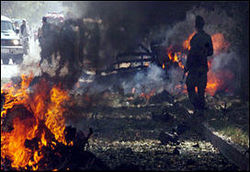
Indian Embassy in Kabul
In early August, American intelligence agencies supported the claim that members of the ISI helped plan the attack, which they based upon “intercepted communications,” and that, “American officials said that the communications were intercepted before the July 7 bombing, and that the C.I.A. emissary, Stephen R. Kappes, the agency’s deputy director, had been ordered to Islamabad, Pakistan’s capital, even before the attack.” Interestingly, “a top Central Intelligence Agency official traveled to Pakistan [in August] to confront senior Pakistani officials with information about support provided by members of the ISI to militant groups.” However, the CIA knows of these connections, as it has actively supported and financed these covert ISI connections with terrorist organizations. So, what was the real purpose of this top CIA official’s visit to Pakistan?
Days after the CIA released this information to the New York Times, the US accused Pakistan of undermining NATO’s efforts in Afghanistan by supporting Al-Qaeda and the Taliban, and further, “Mike Mc-Connell, the director of national intelligence, and [CIA director] Hayden asked Musharraf to allow the CIA greater freedom to operate in the tribal areas,” and was threatened with “retaliation” if he did not comply. [See: Andrew G. Marshall, Political Destabilization in South and Central Asia: The Role of the CIA-ISI Terror Network. Global Research: September 17, 2008]
The ISI and the CIA
Again, if the ISI is to be blamed for the recent Mumbai attacks, as it has played a part in several attacks and support of terrorism throughout its history, it is important to identify its relationship with the CIA.
The CIA developed close ties with the ISI in the late 1970s, as the CIA used the ISI as a “go-between” for CIA support of the Afghan Mujahideen. This relationship was also pivotal in supporting the Afghan narcotics trade, which again is rampant. The relationship between the two agencies continued throughout the 1990s, in areas such as Chechnya, Yugoslavia and India. [See: Michel Chossudovsky, Al Qaeda and the "War on Terrorism". Global Research: January 20, 2008]
A week prior to the 9/11 attacks, the head of Pakistan’s ISI was on a visit to Washington, D.C., where he met with several key policy figures, such as Deputy Secretary of State, Richard Armitage; Senator Joseph Biden, who is going to be Obama’s Vice President; and with his counterparts in the CIA and Pentagon, and several other officials. He was in Washington right up to and after the 9/11 attacks, and was engaged in several key consultations with US officials, pledging support for the US War on Terror instantly. However, the very same Chief of the ISI also happened to have previously approved of wiring $100,000 to the lead 9/11 hijacker, Mohammed Atta, which was also confirmed by the FBI. Thus, the ISI suddenly became a financier of the 9/11 attacks. Yet, no action was taken against the ISI or Pakistan, apart from the ISI Chief being fired upon this revelation making it into the media.
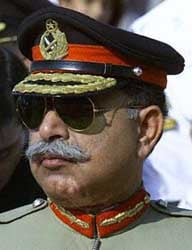
ISI Chief Lt.-General Mahmoud Ahmad
Of significance is that this ISI Chief, Lt.-General Mahmoud Ahmad, was approved as head of the ISI by the US in 1999. From then, he was in close contact and liaison with top officials of the CIA, the Defense Intelligence Agency (DIA), and the Pentagon. [See: Michel Chossudovsky, Cover-up or Complicity of the Bush Administration? Global Research: November 2, 2001]
Collaboration between the ISI and CIA did not end with these disturbing revelations. In 2007, it was reported that the CIA was arming and funding a terrorist organization named Jundullah, based in Pakistan’s tribal areas, with the goal of “sowing chaos” in Iran. Jundullah not only is funded and armed by the CIA, but has extensive ties to Al-Qaeda, and the ISI, as the CIA’s financial support for the group is funneled through the ISI, so as to make it more difficult to establish a link between the CIA and the terrorist outfit. [See: Andrew G. Marshall, Political Destabilization in South and Central Asia, op cit ]
As Michel Chossudovsky pointed out in his article, India’s 9/11, “In September, Washington pressured Islamabad, using the "war on terrorism" as a pretext to fire the ISI chief Lieutenant General Nadeem Taj,” and Pakistani “President Asif Ali Zardari had meetings in New York in late September with CIA Director Michael Hayden.” Following these meetings, “a new US approved ISI chief Lieutenant General Ahmed Shuja Pasha was appointed by the Chief of the Army, General Kayani, on behalf of Washington.”
Anglo-American-Israeli Intelligence and India
In mid-October, American intelligence agencies warned Indian intelligence warned India about an attack “from the sea against hotels and business centers in Mumbai.” Even the Taj Hotel, which became the key area of fighting, was listed as a specific target.[12] In late November, “India’s intelligence services had delivered at least three precise warnings that a major terrorist attack on Mumbai was imminent.”[13]
Immediately following the attacks, it was reported that, “Unprecedented intelligence cooperation involving investigating agencies and spy outfits of India, United States, United Kingdom and Israel has got underway to crack the method and motive behind the Mumbai terrorist massacre, now widely blamed on Islamist radicals who appeared to have all four countries on their hit list when they arrived on the shores of India.” Specifically, “Investigators, forensic analysts, counter-terrorism experts and spymasters from agencies the four countries are converging in New Delhi and Mumbai to put their heads, resources, and skills together to understand the evolving nature of the beast.”
Further, “Washington suggested sending US Special Forces for on-the-ground operations in Mumbai but New Delhi declined the offer, saying its own forces could take care of the situation.” This unprecedented intelligence cooperation was based upon the understanding that, “the manner in which the terrorists who attacked Mumbai are reported to have singled out Americans and Britons, besides pointedly occupying a Jewish center, has revealed that their agenda was wider than just domestic discontent or the Kashmir issue.”[14]
Shortly after the attacks began, it was reported that FBI agents were quickly flown to Mumbai to help in investigating the Mumbai attacks.[15] Israel also offered to send in its “crack commandos to Mumbai to rescue Israeli hostages held in a Jewish centre,” which was refused by India, which led to Israeli media criticizing India’s response to the attacks as “slow, confused and inefficient.”[16]
The Terrorists
Hours after the attacks began on November 26, it was reported that two terrorists were killed and two others were arrested.[17] Later on, reports surfaced in which Indian police had killed four of the Mumbai terrorists and arrested nine of them.[18] The international media was full of this reported capture of nine terrorists.
Interestingly, by November 29, the story had changed. All of a sudden, Mumbai cops had only “nabbed” one terrorist. This person has effectively become the nail-in-the-coffin for laying the blame at Pakistan’s door. As soon as this person was caught, he began to sing like a canary, and said that, “all [the] terrorists were trained in marine warfare along with the special course Daura-e-Shifa conducted by the Lashkar-e-Taiba in what at once transforms the nature of the planning from a routine terror strike and into a specialized raid by commandos.” He also stated that the terrorists “were made to believe by their Lashkar bosses that they were not being sent on a suicide mission and that they would be coming back alive.” He also revealed the names of his fellow terrorists, all of them Pakistani citizens.[19]
Along the same lines, another very interesting mystery of the Mumbai massacre is the early reports of British involvement. Shortly following the outbreak of violence, Indian authorities stated that, “Seven of the Mumbai terrorists were British Pakistanis,” and that, “two Brits had been arrested and another five suspects were from the UK.” Further, Blackberry phones found on the suspects contained “a lot of content” connecting them with the UK.[20] The Chief Minister of Mumbai had early on reported that, “two British-born Pakistanis were among eight gunmen seized by Indian commandos who stormed buildings to free hostages.”[21]
On December 1, the Daily Mail reported that, “As many as seven of the terrorists may have British connections and some could be from Leeds and Bradford where London's July 7 bombers lived.” As a result of these revelations, Scotland Yard anti-terrorist detectives were sent to Mumbai “to assist in the investigation.” There was also speculation that one particular British Al-Qaeda suspect may have helped plan the assault, and just happened to be killed a week earlier in Pakistan by the CIA. That person was Rashid Rauf.[22] This is the same Rashid Rauf who was at first declared the mastermind of the London liquid bomb plot, who had close ties with the ISI and Al-Qaeda, who was subsequently arrested by the ISI, and then miraculously “escaped” from Pakistani custody. Barely a week before the Mumbai Massacre, Rauf was reportedly killed by a CIA drone attack on a militant Islamic base in Pakistan’s tribal region.
Early on, there was an incident in which a taxicab was blown up in Mumbai, with the driver and passenger killed. The taxi started moving through a red light when the car bomb exploded, which ended up saving the lives of “hundreds,” as opposed to if the car had moved when the light was green and intersection was full. This ensured that the only ones who died were those in the taxi.[23] This sparked an investigation into whether the driver “was aware that his car was loaded with explosives.”[24]
Why is this significant? Because this closely resembles tactics used in Iraq since the Anglo-American occupation of the country, employed by both US and British intelligence and special forces in an effort to sow chaos and create civil strife and war. [See: Andrew G. Marshall, State-Sponsored Terror: British and American Black Ops in Iraq. Global Research, June 25, 2008]
Means, Modus Operandi and Motive
Means
While the possibility that Pakistan and the ISI (or Lashkar-e Taiba) are responsible for the Mumbai attacks should be taken into consideration, given precedence and means, we must allow ourselves to contemplate other possibilities.
While India and the west are placing the blame for the attacks on Pakistan’s ISI and the Lashkar-e Taiba, the Pakistani press is reporting on another possibility.
On November 29, the Pakistan Daily reported that, with a stiff side of anti-Israel rhetoric, that the Mumbai attack would be used “as justification for a US invasion of Pakistan.” It reported that the Israeli Mossad “has mobilized since 2000 in the Jammu and Kashmir areas of India, where the Indian government has been pursuing a ‘security’ issue with regard to the Kashmiri people.” It quoted a Times of India article that reported, “Israeli counter-terrorism experts are now touring Jammu and Kashmir and several other states in India at the invitation of Home Minister Lal Krishna Advani to make an assessment of New Delhi’s security needs. The Israeli team, headed by Eli Katzir of the Israel Counter-Terrorism Combat Unit, includes Israeli military intelligence officials and a senior police official.” There was also a reported agreement on “closer India-Israeli cooperation on all security matters.”[25]
Modus Operandi
Shortly after the start of the attacks in Mumbai, a Russia counter-terrorism presidential envoy stated that, “The terrorists in the Indian city of Mumbai, who killed more than 150 people and injured over 300, used the same tactics that Chechen field militants employed in the Northern Caucasus.” He elaborated, “These tactics were used during raids by militant Chechen field commanders Shamil Basayev and Salman Raduyev against the towns of Buddyonnovsk and Pervomaiskoye. For the first time in history the entire towns were terrorized, with homes and hospitals seized. The Mumbai terrorists have learned these tactics well.”[26]
Shamil Basayev, one of the Chechen rebel leaders, as well as many of the other Chechen leaders, were trained by the CIA and ISI in Afghanistan, in CIA-run training camps during the Soviet-Afghan war of the 1980s.[27]
Motive
On December 2, former ISI Chief Hameed Gul, said that the “Mumbai incident is an international based conspiracy to deprive Pakistan of its atomic power. Talking to a private TV channel on Friday, he said that to involve Pakistan in the incident reflected that some forces wanted to declare Pakistan a fail[ed] state as somehow it had become necessary to make Pakistan kneel down in order to snatch its atomic power away.” He elaborated that the method of attacks, and how the militants executed them, “seemed impossible without internal support.” He continued in stating that the “US wanted to see [the] Indian army in Afghanistan to disintegrate the country,” and referred to recent US maps showing a divided Pakistan in four parts, and that making Pakistan “kneel down” before the IMF was “part of a pre-planned trick.”[28]
As astonishing and outlandish as these claims may seem, the US has a long history of turning on its allies when they seek to become self-sufficient and developed, such as with Saddam Hussein and Iraq in the early 1990s. Also, it is vital to note the role of the IMF and World Bank in creating economic crises, and thus, political-social-ethnic instability, which invariably has led to all out ethnic war, genocides and “international interventions,” in countries such as Yugoslavia and Rwanda.
The International Financial Institutions (IFIs) often create the conditions for political instability, while covert Western intelligence support to disaffected and radical groups creates the means for rebellion; which then becomes the excuse for foreign military intervention; which then secures an imperial military presence in the region, thus gaining control over the particular region’s resources and strategic position. This is the age-old conquest of empire: divide and conquer.
Interesting to note is that in 2008, “Pakistan was again seeking IMF help. On Nov. 25, it won final approval on a $7.6 billion loan package after foreign reserves shrank 74 percent to $3.5 billion in the 12 months ended on Nov. 8.”[29] This loan was approved a day before the Mumbai attacks began. On December 4, it was reported that, “Tough conditions of International Monetary Fund (IMF) have now started surfacing as IMF and the Government of Pakistan (GoP) agreed to discontinue oil import support, eliminate power subsidies and budgetary support of the government, public and private entities. IMF and GoP have agreed to phase out the State Bank of Pakistan’s (SBPs) provision of foreign exchange for oil imports.” On top of this, “further steps will be taken during the remainder of the fiscal year to strengthen tax enforcement. Moreover, fuel prices will continue to be adjusted to pass through changes in international prices.” Further, “The programme envisages a significant tightening of monetary policy.”[30]
The results of these conditionalities are predictable: Pakistan will lose all subsidies; fuel prices will drastically rise, as will food and other necessary commodity prices. At the same time, a tightening of monetary policy and World Bank/IMF control over Pakistan’s central bank will prevent Pakistan from taking measures to curb inflation, and the cost of living will skyrocket as the currency value plummets. All this is going on while taxes are increased and expanded greatly, and public jobs such as bureaucratic positions, education, etc., are downsized or altogether disbanded. Money will likely continue to flow to the ISI and Army, which will create discontent among Pakistan’s deprived and disillusioned. A military coup would be likely, followed by rebellion en masse, which would in turn pit the various ethnicities against one another. This could lead to either a war against India, ultimately ending with a consolidated national security state to act as a conduit for Anglo-American imperial ambitions, such as in Rwanda; or, it could result in ethnic conflict and wars, ultimately ending up in the break-up of Pakistan into smaller states divided among ethnic lines, such as in Yugoslavia. Or, it could end with a combination of the two, a divided, warring, region engulfed in crisis.
The break up of Pakistan is not a far-fetched idea in terms of Anglo-American strategy. In fact, the plan for the destabilization and ultimately, balkanization of Pakistan has originated in Anglo-American-Israeli military strategic circles. As I previously documented in Divide and Conquer: The Anglo-American Imperial Project [Global Research, July 10, 2008], the destabilization and balkanization of the near-entire Middle East and Central Asia has been a long-held strategy for the Anglo-America-Israeli Axis since the late 1970s and early 1980s.
Divide and Conquer
This concept evolved in strategic planning circles in the late 1970s in response to regional nationalist tendencies in the Middle East and Central Asia, as well as a perceived threat of growing Soviet influence in the region. The central aim of these strategic thinkers was to secure Middle Eastern oil and Central Asian gas reserves and pipeline routes under the control of the Anglo-Americans. Control over these vital energy reserves is a strategic as much as economic concern, as most of the world gets its energy from this area; so those who control the energy, control who gets it, and thus, control much of the world. The economic benefits of Anglo-Americans controlling the regions energy reserves cannot be analyzed separately from strategic interests, as they are one and the same. Anglo-American oil companies gain control of the oil and gas, while the British and American governments install puppet regimes to look after their interests; and to act as proxies in creating conflicts and wars with countries of the region who act in their own national interest, as opposed to acting under the guidance of and submission to the Anglo-Americans.
Arc of Crisis
After the 1973 oil shocks, which were, in fact, promoted and covertly orchestrated by Anglo-American banking and oil interests, the oil producing nations grew very wealthy, such as Iran. As well as this, countries like Afghanistan were becoming increasingly leftist and progressive. Fearing possible alliances developing between Middle Eastern and Central Asian countries with the Soviet Union, as well as the even greater threat of these countries becoming truly independent, taking control of their own resources for the good of their own people; Anglo-American strategists turned to what is called the “Arc of Crisis.”
The “Arc of Crisis” describes the “nations that stretch across the southern flank of the Soviet Union from the Indian subcontinent to Turkey, and southward through the Arabian Peninsula to the Horn of Africa.” Further, the “center of gravity of this arc is Iran.” In 1978, Zbigniew Brzezinski gave a speech in which he stated, “An arc of crisis stretches along the shores of the Indian Ocean, with fragile social and political structures in a region of vital importance to us threatened with fragmentation. The resulting political chaos could well be filled by elements hostile to our values and sympathetic to our adversaries.”[36]
Anglo-American strategy in the region thus developed and changed at this time, as “There was this idea that the Islamic forces could be used against the Soviet Union. The theory was, there was an arc of crisis, and so an arc of Islam could be mobilized to contain the Soviets. It was a Brzezinski concept.”[37] Bilderberg member, Bernard Lewis, presented a British-American strategy to the Bilderberg Group during the 1979 meeting, which, “endorsed the radical Muslim Brotherhood movement behind Khomeini, in order to promote balkanization of the entire Muslim Near East along tribal and religious lines. Lewis argued that the West should encourage autonomous groups such as the Kurds, Armenians, Lebanese Maronites, Ethiopian Copts, Azerbaijani Turks, and so forth. The chaos would spread in what he termed an ‘Arc of Crisis,’ which would spill over into the Muslim regions of the Soviet Union.”[38] Since the Soviet Union was viewed as a secular and atheist regime, having oppressed religion within its sphere of influence, the rise of radical Islamic influence and governments in the Middle East and Central Asia would ensure that Soviet influence would not enter into the region, as radical Muslims would view the Soviets with more distrust than the Americans. The Anglo-Americans positioned themselves as the lesser of two evils.
Bernard Lewis was a former British intelligence officer and historian who is infamous for explaining Arab discontent towards the West as not being rooted in a reaction toward imperialism, but rather that it is rooted in Islam; in that Islam is incompatible with the West, and that they are destined to clash, using the term, "Clash of Civilizations." For decades, "Lewis played a critical role as professor, mentor, and guru to two generations of Orientalists, academics, U.S. and British intelligence specialists, think tank denizens, and assorted neoconservatives." In the 1980s, Lewis "was hobnobbing with top Department of Defense officials."[39] Lewis wrote a 1992 article in Foreign Affairs, the journal of the Council on Foreign Relations, titled, "Rethinking the Middle East." In this article, Lewis raised the prospect of another policy towards the Middle East in the wake of the end of the Cold War and beginnings of the New World Order, "which could even be precipitated by fundamentalism, is what has of late become fashionable to call 'Lebanonization.' Most of the states of the Middle East - Egypt is an obvious exception - are of recent and artificial construction and are vulnerable to such a proc ess. If the central power is sufficiently weakened, there is no real civil society to hold the polity together, no real sense of common national identity or overriding allegiance to the nation-state. The state then disintegrates - as happened in Lebanon - into a chaos of squabbling, feuding, fighting sects, tribes, regions and parties."[40]
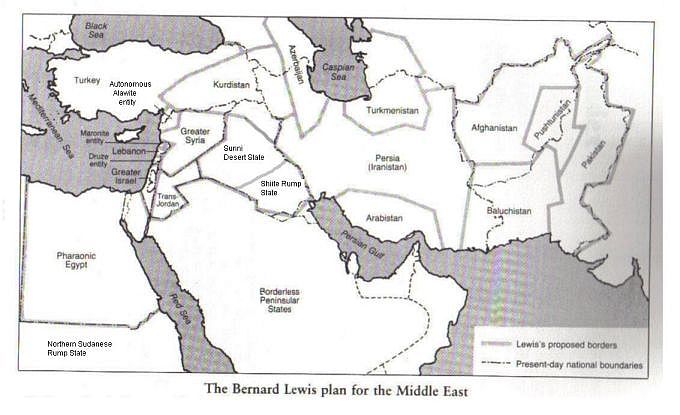
Bernard Lewis' Redrawn Map of the "Arc of Crisis"
A Foreign Affairs article of 1979, the journal put out by the powerful Council on Foreign Relations (CFR), discussed the Arc of Crisis: “The Middle East constitutes its central core. Its strategic position is unequalled: it is the last major region of the Free World directly adjacent to the Soviet Union, it holds in its subsoil about three-fourths of the proven and estimated world oil reserves, and it is the locus of one of the most intractable conflicts of the twentieth century: that of Zionism versus Arab nationalism.” It explained that US strategy in the region was focused with “containment” of the Soviet Union as well as access to the regions oil. [41]
It was in this context that in 1979, as Zbigniew Brzezinski later admitted, “According to the official version of history, CIA aid to the Mujahadeen began during 1980, that is to say, after the Soviet army invaded Afghanistan, 24 Dec 1979. But the reality, secretly guarded until now, is completely otherwise Indeed, it was July 3, 1979 that President Carter signed the first directive for secret aid to the opponents of the pro-Soviet regime in Kabul. And that very day, I wrote a note to the president in which I explained to him that in my opinion this aid was going to induce a Soviet military intervention.” He claimed that, “We didn't push the Russians to intervene, but we knowingly increased the probability that they would.” What a perfect example of what George Orwell would call “double-speak,” saying that the Americans “didn’t push the Russians to intervene” but rather, “increased the probability that they would.” In other words, they “pushed” them to intervene.[42]
This is when the Mujahideen were created, and through this, Al-Qaeda, and a variety of other radical Islamic groups which have come to plague global geopolitics since this era. Terrorism cannot be viewed, as it often is, in such a simple manner as “non-state actors” reacting to geopolitics of nations and corporations. In fact, many terrorist groups, particularly the largest, most well organized, extremist and violent ones, are “proxy state actors,” receiving covert support – through arms and training – by various state intelligence agencies. They are not simply “reacting” to geopolitics, but are important players in the geopolitical chessboard. They represent the perfect excuse for foreign militaristic adventurism and war; domestic tyranny in the form of developing police states to control populations, stifle dissent and create a totalitarian base of control.
As the San Francisco Chronicle wrote in September of 2001, shortly after the 9/11 attacks, “The map of terrorist sanctuaries and targets in the Middle East and Central Asia is also, to an extraordinary degree, a map of the world's principal energy sources in the 21st century. The defense of these energy resources -- rather than a simple confrontation between Islam and the West -- will be the primary flash point of global conflict for decades to come.” Further, it stated: “It is inevitable that the war against terrorism will be seen by many as a war on behalf of America's Chevron, ExxonMobil and Arco; France's TotalFinaElf; British Petroleum; Royal Dutch Shell and other multinational giants, which have hundreds of billions of dollars of investment in the region.”[43] Indeed, where Al-Qaeda is present, the US military follows, and behind the military, the oil companies wait and push; and behind the oil companies, the banks cash in.
Balkanizing the Middle East
In 1982, Oded Yinon, an Israeli journalist wrote a report for a publication of the World Zionist Organization in which he advocated, “The dissolution of Syria and Iraq into ethnically or religiously unique areas such as in Lebanon [which] is Israel's primary target on the Eastern front. Iraq, rich in oil on the one hand and internally torn on the other is guaranteed as a candidate for Israel's targets. Its dissolution is even more important for us than that of Syria. Iraq is stronger than Syria. In the short run, it is Iraqi power which constitutes the greatest threat to Israel.”
In 1996, an Israeli think tank with many prominent American neo-conservatives, issued a report in which they advocated for Israel to “Work closely with Turkey and Jordan to contain, destabilize, and roll-back some of its most dangerous threats,” among them, to remove Saddam Hussein from power.
In 2000, the Project for the New American Century, an American neo-conservative think tank, published a report called Rebuilding America’s Defenses, in which they openly advocated for an American empire in the Middle East, focusing on removing the “threats” of Iraq and Iran.
Shortly after the US invasion of Iraq, prominent members of the Council on Foreign Relations had begun advocating the break-up of Iraq into at least three smaller states, using Yugoslavia as an example of how to achieve this.
In 2006, the Armed Force Journal published an article by retired Lieutenant-Colonel Ralph Peters, which called for the redrawing of the borders of the Middle East. He first advocated the breakup of Iraq, and that, “Saudi Arabia would suffer as great a dismantling as Pakistan,” and that, “Iran, a state with madcap boundaries, would lose a great deal of territory to Unified Azerbaijan, Free Kurdistan, the Arab Shia State and Free Baluchistan, but would gain the provinces around Herat in today’s Afghanistan.”
Describing Pakistan as “an unnatural state,” he said, “Pakistan’s Northwest Frontier tribes would be reunited with their Afghan brethren,” and that it “would also lose its Baluch territory to Free Baluchistan. The remaining “natural” Pakistan would lie entirely east of the Indus, except for a westward spur near Karachi.” He even made up a helpful little list of “losers” and “winners” in this new great game: as in, who gains territory, and who loses territory. Among the losers are Afghanistan, Iran, Iraq, Israel, Kuwait, Qatar, Saudi Arabia, Syria, Turkey, United Arab Emirates, the West Bank and Pakistan. And Peters made the startling statement that redrawing borders is often only achieved through war and violence, and that “one other dirty little secret from 5,000 years of history: Ethnic cleansing works.”
[See: Andrew G. Marshall, Divide and Conquer: The Anglo-American Imperial Project. Global Research, July 10, 2008]
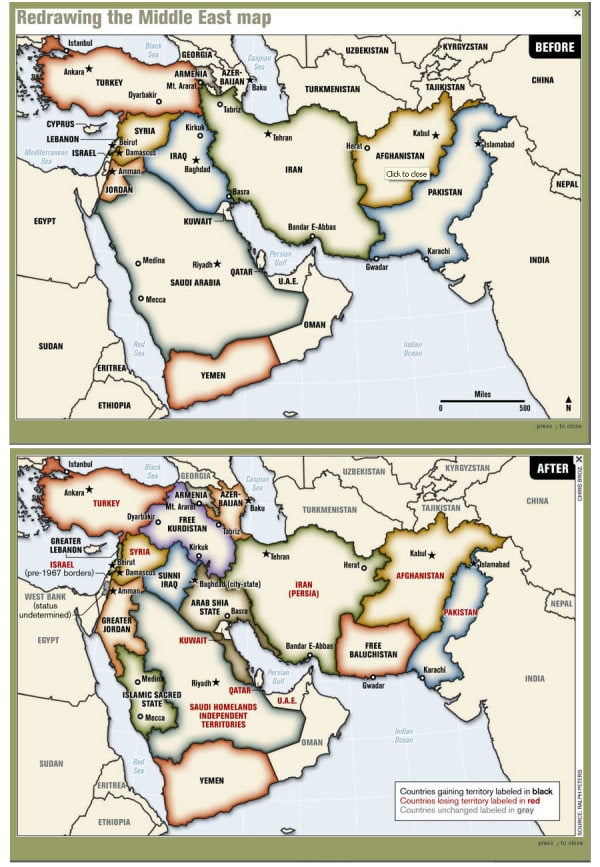
Ralph Peters' Map of a Redrawn Middle East - Note similarity to Bernard Lewis' Map of a Redrawn Middle East
Conclusion
Ultimately, the aims of the Mumbai attacks are to target Pakistan for balkanization. The question of who is responsible – either the ISI, largely rogue of Pakistan’s civilian government and under the authority of Anglo-American intelligence; or separate Indian terrorists, likely supported by the same Anglo-American intelligence community – while important, is ultimately a secondary consideration in comparison to the question of Why?
The Who, What, Where, and When is a show for public consumption; masked in confusion and half-truths, designed to confuse and ultimately frustrate the observer – creating a sense of unease and fear of the unknown. The WHY, on the other hand, is the most important question; once you discover the why, the who, where, what, and when begin to fall into place, and create a full picture.
If the Mumbai attacks were designed to be blamed on Pakistan – as they likely were – and thus, to possibly start a war between Pakistan and India – which is now a growing reality – what is the ultimate significance of knowing if it was the ISI or Indian elements responsible? Albeit, this is important to know, however, when it comes to understanding the motives behind the attacks, it pales in comparison.
Pakistan is a strategic lynch-point in the region. Pakistan borders Iran, Afghanistan, India and China. It lies directly below the Central Asian republics of the Former Soviet Union, which are rich in natural gas resources. With NATO’s war in Afghanistan, and the Anglo-Americans in Iraq, and American forces in Saudi Arabia and Kuwait, the occupation of Pakistan would position Western imperial militaries around Iran, the central Middle Eastern target. With the balkanization of Iraq, Afghanistan and Pakistan, destabilizing forces would cross the borders into Iran, ultimately creating the conditions for political and social collapse within the country.
A conflict between Pakistan and India would not only have the effect of dismantling Pakistan, but would also greatly deter India’s rapid economic and social development as the world’s largest democracy, and would force it to come under the influence or “protection” of Western military might and International Financial Institutions. The same is likely for China, as destabilization would cross Pakistan’s borders into the most populated country on earth, exacerbating ethnic differences and social disparities.
A large Anglo-American military presence in Pakistan, or, alternatively, a NATO or UN force, combined with the already present NATO force in Afghanistan, would be a massive military strategic position against advancement of China, Russia or India into the region. With China’s massively increasing influence in Africa threatening Anglo-American and European domination of the continent, a massive military presence on the border of China could act as a powerful warning.
The Mumbai attacks do not aid India, Pakistan, Afghanistan, or any nation within the region. The beneficiaries of the Mumbai Massacre are in London and New York, in the boardrooms and shareholders of the largest international banks; which seek total control of the world. Having dominated North America and Europe for much of recent history, these bankers, primarily Anglo-American, but also European, seek to exert their total control over the world’s resources, currencies, and populations. There are many concurrent strategies they are employing to achieve this end: among them, the global financial crisis, to reign in and control the world economy; and a “total war” in the Middle East, likely escalating into a World War with Russia and China, is the perfect tool to strike enough fear into the world population to accept an over-arching supranational governance structure – to ensure no future wars occur, to ensure stability of the global economy – a utopian vision of a single world order.
The problem with utopias is that they are “ultimate ideals,” and if humanity has learned anything in its history on this planet; it is that perfection is impossible, be it in the form of an “ideal person” or an “ideal government;” humanity is plagued by imperfections and emotion. Accepting our imperfections as a species is what can make us great, and understanding that a utopian ideal is impossible to achieve is what can allow us to create the “best possible” society we can have. All utopias attempted throughout history have always turned into dystopias. We must learn from humanity’s history of sordid flaws; and only when we accept that we are not perfect, and cannot ever become perfect, in person or in politics, are we free to become humanity at it’s most advanced and at its most noble.
Notes
[1] Damien McElroy and Rahul Bedi, Mumbai attacks: 300 feared dead as full horror of the terrorist attacks emerges. The Telegraph: November 30, 2008: http://www.telegraph.co.uk/news/3536220/Mumbai-siege-300-feared-dead-as-full-horror-of-the-terrorist-attacks-emerges.html
[2] Andrew Buncombe and Jonathan Owen, Just ten trained terrorists caused carnage. The Independent: November 30, 2008: http://www.independent.co.uk/news/world/asia/just-ten-trained-terrorists-caused-carnage-1041639.html
[3] Maseeh Rahman, Mumbai terror attacks: Who could be behind them? The Guardian: November 27, 2008: http://www.guardian.co.uk/world/2008/nov/27/mumbai-terror-attacks-india8
[4] Hasan Suroor, U.K. intelligence suspects Al-Qaeda hand. The Hindu: November 28, 2008: http://www.hindu.com/2008/11/28/stories/2008112860481700.htm
[5] Press TV, India links Mumbai attackers to Pakistan. Press TV: November 28, 2008: http://www.presstv.ir/detail.aspx?id=76797§ionid=351020402
[6] Agencies, India blames Pakistan for Mumbai attacks. Gulf News: November 28, 2008:
http://www.gulfnews.com/world/India/10263289.html
[7] Mark Mazzetti, U.S. Intelligence Focuses on Pakistani Group. The New York Times: November 28, 2008:
http://www.nytimes.com/2008/11/29/world/asia/29intel.html?_r=3&em
[8] SATP, Lashkar-e-Toiba: 'Army of the Pure'. South Asia Terrorism Portal: 2001:
http://www.satp.org/satporgtp/countries/india/states/jandk/terrorist_outfits/lashkar_e_toiba.htm
[9] Gethin Chamberlain, Attacker 'was recruited' at terror group's religious school. The Scotsman: July 14, 2005: http://news.scotsman.com/londonbombings/Attacker-was-recruited-at-terror.2642907.jp
[10] Michel Chossudovsky, London 7/7 Terror Suspect Linked to British Intelligence? Global Research: August 1, 2005: http://www.globalresearch.ca/index.php?context=va&aid=782
[11] Michel Chossudovsky, The Foiled UK Terror Plot and the "Pakistani Connection". Global Research: August 14, 2006: http://www.globalresearch.ca/index.php?context=va&aid=2960
[12] Richard Esposito, et. al., US Warned India in October of Potential Terror Attack. ABC News: December 1, 2008: http://abcnews.go.com/Blotter/story?id=6368013&page=1
[13] Praveen Swami, Pointed intelligence warnings preceded attacks. The Hindu: November 30, 2008: http://www.hindu.com/2008/11/30/stories/2008113055981500.htm
[14] Chidanand Rajghatta, US, UK, Israel ramp up intelligence aid to India. The Times of India: November 28, 2008: http://timesofindia.indiatimes.com/World/India_gets_intelligence_aid_from_US_UK/articleshow/3770950.cms
[15] Foster Klug and Lara Jakes Jordan, US sends FBI agents to India to investigate attack. AP: November 30, 2008: http://www.google.com/hostednews/ap/article/ALeqM5gsTS09Q-pwO8Q0F_68FHwrmhCJOgD94OA5A80
[16] IANS, Israeli daily critical of India’s ’slow’ response to terror strike. Thaindian News: November 28, 2008:
http://www.thaindian.com/newsportal/world-news/israeli-daily-critical-of-indias-slow-response-to-terror-strike_100124946.html
[17] IANS, Two terrorists killed, two arrested in Mumbai. Thaindian News: November 27, 2008: http://www.thaindian.com/newsportal/world-news/two-terrorists-killed-two-arrested-in-mumbai_100124003.html
[18] Agencies, Four terrorists killed, nine arrested. Express India: November 27, 2008: http://www.expressindia.com/latest-news/Four-terrorists-killed-nine-arrested/391103/
[19] ToI, Arrested terrorist says gang hoped to get away. The Times of India: November 29, 2008: http://timesofindia.indiatimes.com/Arrested_terrorist_says_gang_hoped_to_get_away/articleshow/3771598.cms
[20] Mark Jefferies, Mumbai attacks: Seven terrorists were British, claims Indian government. Daily Record: November 29, 2008: http://www.dailyrecord.co.uk/news/uk-world-news/2008/11/29/mumbai-attacks-seven-terrorists-were-british-claims-indian-government-86908-20932992/
[21] Jon Swaine, Mumbai attack: 'British men among terrorists'. The Telegraph: November 28, 2008: http://www.telegraph.co.uk/news/worldnews/asia/india/3533472/Mumbai-attack-British-men-among-terrorists.html
[22] Justin Davenport, et. al., Massacre in Mumbai: Up to SEVEN gunmen were British and 'came from same area as 7/7 bombers'. The Daily Mail: December 1, 2008: http://www.dailymail.co.uk/news/worldnews/article-1089711/Massacre-Mumbai-Up-SEVEN-gunmen-British-came-area-7-7-bombers.html
[23] Debasish Panigrahi, Taxi with bomb jumped signal, saving many lives. The Hindustan Times: November 28, 2008: http://www.hindustantimes.com/StoryPage/FullcoverageStoryPage.aspx?id=505311b6-974c-4d7b-87bb-8b5e29333299Mumbaiunderattack_Special&&Headline=Taxi+with+bomb+jumped+signal%2c+saving+many+lives
[24] Vijay V Singh, Was taxi driver aware of bomb in car? The Times of India: November 29, 2008: http://timesofindia.indiatimes.com/Cities/Mumbai/Was_taxi_driver_aware_of_bomb_in_car/articleshow/3770989.cms
[25] PD, The Israeli Mossad False Flag Opperation Strikes In Mumbai. Pakistan Daily: November 29, 2008:
http://www.daily.pk/world/asia/8383-the-israeli-mossad-false-flag-opperation-strikes-in-mumbai.html
[26] RT, Mumbai terrorists used Chechen tactics. Russia Today: November 29, 2008: http://www.russiatoday.com/news/news/33921
[27] Michel Chossudovsky, Who Is Osama Bin Laden? Global Research: September 12, 2001: http://www.globalresearch.ca/articles/CHO109C.html
[28] PD, Former ISI Chief Mumbai incident international conspiracy to deprive Pakistan of atomic power. Pakistan Daily: December 2, 2008:
http://www.daily.pk/local/other-local/8426-former-isi-chief-mumbai-incident-international-conspiracy-to-deprive-pakistan-of-atomic-power.html
[29] Yoolim Lee and Naween A. Mangi, Pakistan’s Richest Man Defies Terrorism to Expand Bank Empire. Bloomberg: December 3, 2008:
http://www.bloomberg.com/apps/news?pid=20601109&sid=aI3f99JIujV4&refer=home
[30] Sajid Chaudhry, Inevitable conditionalities of IMF start surfacing. The Daily Times: December 4, 2008:
http://www.dailytimes.com.pk/default.asp?page=2008\12\04\story_4-12-2008_pg5_1
[31] Patricia Goldstone, Aaronsohn's Maps: The Untold Story of the Man who Might Have Created Peace in the Middle East. Harcourt Trade, 2007: pages 21-22
[32] Patricia Goldstone, Aaronsohn's Maps: The Untold Story of the Man who Might Have Created Peace in the Middle East. Harcourt Trade, 2007: page 22
[33] Niall Ferguson, Empire: The Rise and Demise of the British World Order and the Lessons for Global Power. Perseus, 2002: pages 193-194
[34] Herbert R. Lottman, Return of the Rothschilds: The Great Banking Dynasty Through Two Turbulent Centuries. I.B. Tauris, 1995: page 81
[35] Patricia Goldstone, Aaronsohn's Maps: The Untold Story of the Man who Might Have Created Peace in the Middle East. Harcourt Trade, 2007: pages 22-23
[36] HP-Time, The Crescent of Crisis. Time Magazine: January 15, 1979:
http://www.time.com/time/magazine/article/0,9171,919995-1,00.html
[37] Peter Dale Scott, The Road to 9/11: Wealth, Empire, and the Future of America. University of California Press: 2007: page 67
[38] F. William Engdahl, A Century of War: Anglo-American Oil Politics and the New World Order. London: Pluto Press, 2004: page 171
[39] Robert Dreyfuss, Devil's Game: How the United States Helped Unleash Fundamentalist Islam. Owl Books, 2005: page 332-333
[40] Bernard Lewis, Rethinking the Middle East. Foreign Affairs, Fall 1992: pages 116-117
[41] George Lenczowski, The Arc of Crisis: It’s Central Sector. Foreign Affairs: Summer, 1979: page 796
[42] Le Nouvel Observateur, The CIA's Intervention in Afghanistan. Global Research: October 15, 2001:
http://www.globalresearch.ca/articles/BRZ110A.html
[43] Frank Viviano, Energy future rides on U.S. war: Conflict centered in world's oil patch. The San Francisco Chronicle: September 26, 2001:
http://www.sfgate.com/cgi-bin/article.cgi?file=/chronicle/archive/2001/09/26/MN70983.DTL
Andrew G. Marshall is a Research Associate of the Centre for Research on Globalization (CRG), specializing on geopolitical issues. He is known for having contributed to breaking the Climate Change consensus in a celebrated 2006 article entitled Global Warming A Convenient Lie, in which he challenged the findings underlying Al Gore's documentary. He is currently studying political science and history at Simon Fraser University, British Columbia.
Andrew G. Marshall is a frequent contributor to Global Research.Global Research Articles by Andrew G. Marshall


