


Showing posts with label Milky Way. Show all posts
Showing posts with label Milky Way. Show all posts
Tuesday, March 19, 2013
Arepo Simulation Of Galaxy Formation
This computer animation, created using new software called Arepo, simulates 9 billion years of cosmic history.
Arepo can accurately follow the birth and evolution of thousands of galaxies over billions of years.
Arepo generates the full variety of galaxies seen locally, including majestic spirals like the Milky Way and Andromeda.
Credit: CfA/UCSD/HITS/M. Vogelsberger (CfA) & V. Springel (HITS)


Saturday, February 16, 2013
NGC 6712 Losing Stars Into The Milky Way Halo
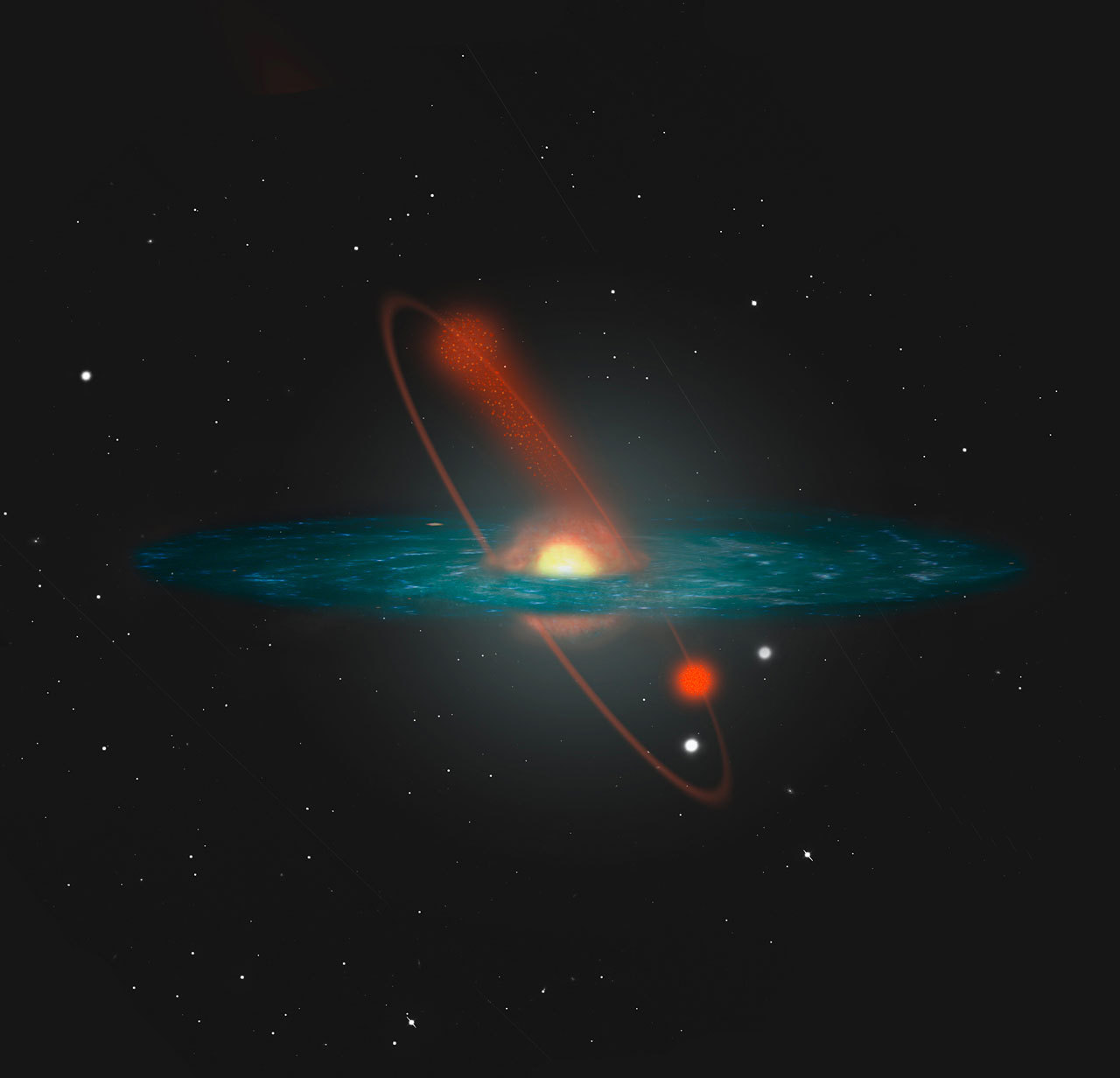
An artistic impression of the orbit of the globular cluster NGC 6712 in the Milky Way.
Due to gravitational disruption, this cluster continuously loses stars, in particular light ones.
This process is enhanced when it passes through the central plane in which most of the Galaxy's stars and nebulae are located.
The cluster emerges in a less dense state after such a passage. The stars that are lost move on in orbits similar to that of the cluster and populate the halo of the Milky Way.
Via: "The European Southern Observatory"
Monday, February 04, 2013
At Least 100 Billion Planets Populate The Galaxy

That's the conclusion of a new study by astronomers at the California Institute of Technology (Caltech) that provides yet more evidence that planetary systems are the cosmic norm. The team made their estimate while analyzing planets orbiting a star called Kepler-32—planets that are representative, they say, of the vast majority in the galaxy and thus serve as a perfect case study for understanding how most planets form.
"There's at least 100 billion planets in the galaxy—just our galaxy," says John Johnson, assistant professor of planetary astronomy at Caltech and coauthor of the study, which was recently accepted for publication in the Astrophysical Journal. "That's mind-boggling."
"It's a staggering number, if you think about it," adds Jonathan Swift, a postdoc at Caltech and lead author of the paper. "Basically there's one of these planets per star."
The planetary system in question, which was detected by the Kepler space telescope, contains five planets. The existence of two of those planets have already been confirmed by other astronomers. The Caltech team confirmed the remaining three, then analyzed the five-planet system and compared it to other systems found by the Kepler mission.
The planets orbit a star that is an M dwarf—a type that accounts for about three-quarters of all stars in the Milky Way. The five planets, which are similar in size to Earth and orbit close to their star, are also typical of the class of planets that the telescope has discovered orbiting other M dwarfs, Swift says. Therefore, the majority of planets in the galaxy probably have characteristics comparable to those of the five planets.
While this particular system may not be unique, what does set it apart is its coincidental orientation: the orbits of the planets lie in a plane that's positioned such that Kepler views the system edge-on. Due to this rare orientation, each planet blocks Kepler -32's starlight as it passes between the star and the Kepler telescope.
By analyzing changes in the star's brightness, the astronomers were able to determine the planets' characteristics, such as their sizes and orbital periods. This orientation therefore provides an opportunity to study the system in great detail—and because the planets represent the vast majority of planets that are thought to populate the galaxy, the team says, the system also can help astronomers better understand planet formation in general.
To do that calculation, the Caltech team determined the probability that an M-dwarf system would provide Kepler-32's edge-on orientation. Combining that probability with the number of planetary systems Kepler is able to detect, the astronomers calculated that there is, on average, one planet for every one of the approximately 100 billion stars in the galaxy.
But their analysis only considers planets that are in close orbits around M dwarfs—not the outer planets of an M-dwarf system, or those orbiting other kinds of stars.
As a result, they say, their estimate is conservative. In fact, says Swift, a more accurate estimate that includes data from other analyses could lead to an average of two planets per star.M-dwarf systems like Kepler-32's are quite different from our own solar system. For one, M dwarfs are cooler and much smaller than the sun. Kepler-32, for example, has half the mass of the sun and half its radius. The radii of its five planets range from 0.8 to 2.7 times that of Earth, and those planets orbit extremely close to their star.
The whole system fits within just over a tenth of an astronomical unit (the average distance between Earth and the sun)—a distance that is about a third of the radius of Mercury's orbit around the sun. The fact that M-dwarf systems vastly outnumber other kinds of systems carries a profound implication, according to Johnson, which is that our solar system is extremely rare.
The implications of a galaxy chock full of planets are far-reaching, the researchers say. "It's really fundamental from an origins standpoint," says Swift, who notes that because M dwarfs shine mainly in infrared light, the stars are invisible to the naked eye. "Kepler has enabled us to look up at the sky and know that there are more planets out there than stars we can see."
Saturday, December 22, 2012
Cosmic Journeys : The Largest Black Holes In The Universe
A supermassive black hole is the largest type of black hole in a galaxy, on the order of hundreds of thousands to billions of solar masses. Most--and possibly all--galaxies, including the Milky Wa y(see Sagittarius A), are believed to contain Supermassive black holes at their centers.
Supermassive black holes have properties which distinguish them from lower-mass classifications. First, the average density of a supermassive black hole (defined as the mass of the black hole divided by the volume within its Schwarzschild radius) can be less than the density of water in the case of some supermassive black holes.
Donald Lynden-Bell and Martin Rees hypothetized in 1971 that the center of the Milky Way galaxy would contain a supermassive black hole. Sagittarius A was discovered and named on February 13 and 15, 1974, by astronomers Bruce Balick and Robert Brown using the baseline interferometer of the National Radio Astronomy Observatory. They discovered a radio source that emits synchrotronic radiation, also it was found to be dense and immobile because of its gravitation. Therefore, the first discovered supermassive black hole existed in the center of the Milky Way.
Supermassive Black Holes Outside The Milky Way
It is now widely accepted that the center of nearly every galaxy contains a supermassive black hole.
It is believed that black holes and their host galaxies coevolved between 300-800 million years after the Big Bang, passing through a quasar phase.
The nearby Andromeda Galaxy, 2.5 million light-years away, contains a (1.1–2.3) × 108 (110-230 million) solar mass central black hole, significantly larger than the Milky Way's.
The largest supermassive black hole in the Milky Way's neighborhood appears to be that of M87, weighing in at (6.4 ± 0.5) × 109 (~6.4 billion) solar masses at a distance of 53.5 million light years.
On 5 December 2011 astronomers discovered the largest super massive black hole yet found to be that of NGC 4889, weighing in at 21 billion solar masses at a distance of 336 million light-years away in the Coma constellation.
Some galaxies, such as Galaxy 0402+379, appear to have two supermassive black holes at their centers, forming a binary system.
Binary supermassive black holes are believed to be a common consequence of galactic mergers. The binary pair in OJ 287, 3.5 billion light years away, contains the previous most massive black hole known (until the December 2011 discovery, with a mass estimated at 18 billion solar masses.
A supermassive black hole was recently discovered in the dwarf galaxy Henize 2-10, which has no bulge. The precise implications for this discovery on black hole formation are unknown, but may indicate that black holes formed before bulges.
On March 28, 2011, a supermassive black hole (SMBH) was for the first time seen tearing a mid-size star apart. That is, according to astronomers, the only likely explanation of the observations that day of sudden X-ray radiation and the follow-up broad-band observations.
The source was previously an inactive galactic nucleus, and from study of the outburst the galactic nucleus is estimated to be a SMBH with mass of the order of a million solar masses. This rare event is assumed to be a relativistic outflow (material being emitted in a jet at a significant fraction of the speed of light) from a star tidally disrupted by the SMBH. A significant fraction of a solar mass of material is expected to have accreted onto the SMBH. Subsequent long-term observation will allow this assumption to be confirmed if the emission from the jet decays at the expected rate for mass accretion onto a SMBH.
Info via: "Wikipedia"
Subscribe to:
Posts (Atom)
