


Due Process and The Japanese-American Internment
Posted by "Sayf Maslul"
Video By "Matthew Shimura"
This is a moving documentary that won CSPAN's 2012 Student Documentary Competition in which 9th student Matthew Shimura from Punahou School in Honolulu, HI detailed the plight of his grandfather and other Japanese citizens during World War II when the US government decided to suspend the constitutional rights of US citizens and declared Japanese Americans as C4 "enemy aliens" without due process.
While many don't know it, it was not only Japanese citizens that were rounded up by the United States. Instead of hundreds of thousands of US citizens including Germans, Italians and political dissidents were also rounded up and hauled off to the concentration camps. Even worse is tens of thousands of American citizens who had their citizenship suspended, including women and children against which there was no evidence for the "enemy alien" designation, were held in the camps for years after the war had ended.
Matthew warns that Americans need to fully understand the gravity of these events which are still clouded in mystery so we can be better prepared and possible try to prevent the government from even again deciding to suspend the inalienable rights the constitution is SUPPOSED to guarantee to us.
Perhaps even more spine-tingling is recollections from Hawaii Senator Daniel Inouye's who recalls how he was serving in the US military during the war and did not even have any knowledge that Americans were being rounded up into concentration camps because the news was censored by the US government
Showing posts with label Japanese-Americans. Show all posts
Showing posts with label Japanese-Americans. Show all posts
Sunday, May 06, 2012


Friday, May 04, 2012
We Japanese Americans Must Not Forget Our Wartime Internment
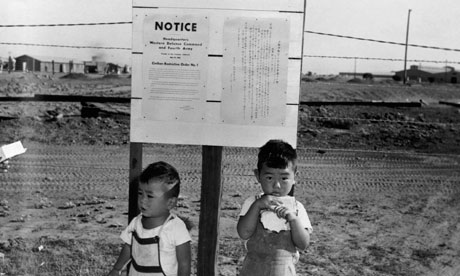
Two Japanese children stand underneath a notice detailing 'Civilian Restrictive Order No 1' outside the Pinedale assembly centre, California, in 1942. Photograph: Us Army Signal Corps/ CORBIS
The Degrading Treatment Of Japanese American Families Like Mine Is The Theme Of My New Musical, Allegiance
By George Takei
Friday 27 April 2012 15.15 EDT
Courtesy Of "The Guardian"
Seventy years ago, US soldiers bearing bayoneted rifles came marching up to the front door of our family's home in Los Angeles, ordering us out. Our crime was looking like the people who had bombed Pearl Harbor a few months before. I'll never forget that day, nor the tears streaming down my mother's face as we were forcibly removed, herded off like animals, to a nearby race track. There, for weeks, we would live in a filthy horse stable while our "permanent" relocation camp was being constructed thousands of miles away in Arkansas, in a place calledRohwer.
I recently revisited Rohwer. Gone were the sentry towers, armed guards, barbed wire and crudely constructed barracks that defined our lives for many years. The swamp had been drained, the trees chopped down. Only miles and miles of cotton fields. The only thing remaining was the cemetery with two tall monuments.
Because I was a child, I didn't understand the depth of the degradation and deprivation my parents suffered, or how courageous and foresighted my mother had been to smuggle a sewing machine into camp, which permitted her to make modest curtains for our bare quarters. I didn't grasp what a blow the ordeal was to my father's role as provider, as he struggled to keep our family together. The family ate, bathed and did chores along with a whole community, pressed together in the confines of a makeshift camp, in the oppressive heat and mosquito-infested swamps of Arkansas.
Later my family would be shipped to a high-security camp in Tule Lake, California, constructed in a desolate, dry lake bed in the north of the state. Three layers of barbed-wire fences now confined us. Out of principle, my parents had refused to answer yes to a "loyalty" questionnaire the government had promulgated. It had asked whether they would serve in the US army and go wherever ordered, and whether they would swear allegiance to the US government and "forswear" loyalty to the Japanese emperor – as if any had ever sworn such loyalty in the first instance.
Because the government had already taken so much from us, and broken its promise of "liberty and justice for all", how could my parents give them the satisfaction of a forced oath? I still remember the irony of holding my hand to my heart and pledging allegiance to the US flag in the tar-paper barrack schoolroom, even as armed guards watched over us and barbed wire kept us locked inside that prison, without charge, trial or due process.
My father once said: "America is a democracy as great as the people can be, but also as fallible." When I was a teenager, I began to understand better what had been done to us, and to question my own father about it. In one heated exchange, I said to him angrily: "Why didn't you do anything, Daddy? You led us like sheep to slaughter!" And for the first time, I saw the great sadness in his eyes as he said simply,: "Maybe you're right" – and turned and walked from the table, shutting his bedroom door behind him.
I will always regret those words. The tragedy of the internment of 120,000 Japanese Americans was not only that it was the greatest violation of our constitutional guarantees, but that it broke apart families and whole communities, and left scars that today remain unhealed, even after the government later apologised and issued reparations. It was almost a half-century too late. President Ronald Reagan only reluctantly signed the Civil Liberties Act of 1988. It expressed regret for the injustice and paid a token redress of $20,000 to those survivors still alive. My father had already passed away in 1979, never to know of the apology or receive the redress money. I donated the sum to the most fitting institution, the Japanese American National Museum, which tells the story of the experience of Americans of Japanese ancestry.
When I returned to Rohwer this year, it was not in anger or sadness, but with a deep resolve to help ensure such a thing never happens again within our shores. I will soon be appearing in Allegiance, the first piece of American musical theatre to ever address the subject of the internment, which remains one of the darkest and most little-known chapters of our history. We also plan to bring the show to the great stage of Broadway next year, so that the world can hear the story and our profound message: "Never forget, never again."
Subscribe to:
Comments (Atom)
