AMY GOODMAN: As the country marks Presidents’ Day today, we turn to an aspect of U.S. history often missed: the complicity of American presidents with slavery. The first person of African descent to enter the White House was most likely a slave. The nation’s capital, Washington, D.C., once hosted markets where human beings were sold for profit. Slaves built some of the country’s most famous landmarks, including Philadelphia’s Independence Hall, Boston’s Faneuil Hall, James Madison’s Montpelier. Last week, President Obama mentioned the role of slaves in building one specific landmark: Thomas Jefferson’s plantation estate in Charlottesville, Virginia. Obama was touring the home of America’s third president with French leader François Hollande. This is what Obama had to say about Monticello.
PRESIDENT BARACK OBAMA: This house also represents a complicated history of the United States. We just visited downstairs, where we know that slaves helped to build this magnificent structure, and the complex relations that Jefferson, the drafter of the Declaration of Independence, had to slavery. And it’s a reminder for both of us that we are going to continue this fight on behalf of the rights of all peoples, something that I know France has always been committed to and we are committed to, as well.
AMY GOODMAN: President Obama speaking last week during French President François Hollande’s visit to the U.S.
We’re joined now by Clarence Lusane, who has documented the racial history of Washington, D.C., and the presidency. His most recent
article is "Missing from Presidents’ Day: The People They Enslaved." Clarence Lusane writes, quote, "more than one in four U.S. presidents were involved in human trafficking and slavery. These presidents bought, sold, and bred enslaved people for profit. Of the 12 presidents who were enslavers, more than half kept people in bondage at the White House," he writes. Clarence Lusane is author of
The Black History of the White House, a member of the D.C. Commission on African American Affairs, also professor at American University in Washington, D.C.
Professor Lusane, welcome to Democracy Now! So, talk about this history of slavery and U.S. presidents.
CLARENCE LUSANE: Well, I’m glad that you pointed out that President Obama, when he went to Jefferson’s home, pointed out the slave history there. But it’s also important to note that the most iconic building in the U.S., the one that represents the country to the world, the White House, also was a place where slavery existed. Not only that, it was built by slaves. And none of that has been publicly acknowledged. There is over a million people who visit the White House every year, who go on tours, who come for meetings, and you can go through that building and never have a sense of that important history.
And that’s critical because I think Presidents’ Day should be a period of critical reflection, not some kind of blind celebration, but it should be one where we really try to get a better sense of the country’s history. And part of that history, part of what I think resonates even to this day, is that, significantly, before the Civil War, nearly every U.S. president was a slave owner, which meant that they were compromised on the issue of slavery, and that had repercussions that, you know, redounded through history. So it’s really critical, I think, that we have that acknowledgment, because we grow up, we go to school, we have history classes, and none of that history is told to us.
AMY GOODMAN: So, give us a black history of U.S. presidents, as you call it.
CLARENCE LUSANE: Well, in looking at the White House—and I use that as the prism to try to look at this longer history that basically led up to President Obama—one of the things that we find that’s missing in that history is the voices of people, particularly African Americans, who were enslaved during that long, long, long history. And that was critical because when you think about George Washington, Madison, Monroe, all of the early presidents, who wrote the Declaration of Independence, they wrote the Constitution, they wrote the Articles of Confederation, all of these documents, these founding documents that extol the principles of democracy, liberty, equality, they were living a contradiction. And that contradiction is that every single day of their life, every moment in their life, they were surrounded by people who were enslaved.
Now, fortunately, because of some of the historic records that have been kept, we now know who some of those people were. George Washington, for example, when he was president and his presidency was in Philadelphia, had at least nine individuals with him who were enslaved—Oney Maria Judge, for example, who was a young woman of about 22 who escaped from George Washington. She escaped—this was in 1796, when she found out that Martha Washington was planning to give her away as a wedding gift. And she made contact with the free black population in Philadelphia, was able to escape. Now, this is remarkable because we’re talking about a young woman who basically traveled nowhere by herself, who escapes from the most powerful person on the planet, pretty much, certainly most powerful person in the United States. Her story is important because she lived—she outlived Washington. She lived to be, I believe, in her eighties and lived a life where she learned to read, became active in her community. You also had Hercules, who was Washington’s cook, who also escaped from Washington.
So there are people who we were in and around the White House who had stories to tell that are part of that history that we literally were never taught about for all of the years that, you know, we took schooling and we took classes in history. And so, I thought it was important, and there are others who have written to re-enter into the historic narrative the stories of these individuals, because they really are critical if you really want to understand the politics of George Washington or the politics of Thomas Jefferson or any of the other presidents who held slaves.
AMY GOODMAN: Tell us about Paul Jennings.
CLARENCE LUSANE: Paul Jennings, again, is another fascinating character. He was enslaved to the Madisons, to James and Dolly Madison. He was, in fact, the first individual to actually write about working in the White House. He published a memoir—this was in the late 1860s—that talked about the time when he was in the White House. And he was there in 1814. He was there when the British literally were burning down the city, and was part of the contingent of folks who were attempting to get materials out of the White House and preserve them before the British came. So he really had a fascinating history.
He was supposed to be free when James Madison died, but Dolly Madison basically reneged on the deal. So he—it took him a few years to buy his freedom, which he eventually did. And then he actually came to help Dolly Madison. She fell on hard times. She wasn’t wealthy. She wasn’t a wealthy person, and she wasn’t part of the social elite of Washington. And so, when she fell on hard times and her family and friends abandoned her, Jennings would often bring her food and bring her money and basically would look after her. But what was also important about James Jennings is that he also was—
AMY GOODMAN: Paul Jennings.
CLARENCE LUSANE: Paul Jennings, I’m sorry, is that he was also central to the largest attempt at escaping from slavery that happened in Washington, D.C. This happened in 1848. For a number of reasons, the escape attempt failed, but Jennings was never brought in. He was never seen as being part of it. And it was only literally after his death that it was revealed that he had played a very critical role in that. So, my point is that you had these individuals who were enslaved to presidents, who really had fascinating kinds of stories and fascinating kinds of lives that we should know about, because they really are also a part of the history of the White House and the history of the presidency.
AMY GOODMAN: I want to play a clip from the trailer of the film Lincoln, directed by Steven Spielberg, released last year, about President Abraham Lincoln and the fight to end slavery in the United States. In this clip, you first hear Abraham Lincoln, played by Daniel Day-Lewis, followed by the voices of Thaddeus Stevens, the congressmember from Pennsylvania, and Mary Todd Lincoln, the first lady. Let’s go to that clip.
PRESIDENT ABRAHAM LINCOLN: [played by Daniel Day-Lewis] We’re stepped out upon the world stage now, the fate of human dignity in our hands! Blood’s been spilt to afford us this moment! Now! Now! Now!
THADDEUS STEVENS: [played by Tommy Lee Jones] Abraham Lincoln has asked us to work with him to accomplish the death of slavery.
MARY TODD LINCOLN: [played by Sally Field] No one’s ever been loved so much by the people. Don’t waste that power.
AMY GOODMAN: That was an excerpt of Lincoln. Clarence Lusane, talk about Abraham Lincoln and slavery.
CLARENCE LUSANE: Lincoln was—the Lincoln administration was a turning point in terms of the history of the relationship between African Americans and the White House. It was during Lincoln’s tenure that the first meeting took place between a U.S. president and leaders of the black community. This happened in 1862, I believe. Now, this was critical because up until that point, although African Americans, particularly free African Americans in the North, had been organized and had been raising issues, policy issues, issues around slavery, they simply had no access to the White House or to policymakers. Lincoln, however, opened up some of that space.
And part of what I think moved Lincoln from being not just simply anti-slavery, but ultimately to recognizing that you had to eliminate slavery, that abolition was the only path forward, in part, came because of his discussions with black leaders, not only church leaders, but people like Frederick Douglass, but also—and this is in the film—discussions with Elizabeth Keckley. In the film, she’s the woman who’s often seen with Mary Lincoln. She’s played by Reuben, Gloria Reuben, in the film. And the film is a little bit disingenuous in that you could think that maybe she was a servant, but in fact she was an independent businesswoman who had become basically best friends with Mary Lincoln, but also she spent a great deal of time at the White House having discussions with Abraham Lincoln about race, about slavery, about the future of the country. And again, her story is important to be told because she, again, was part of a contingent of African Americans who thought to influence the presidency and to address issues that needed to be dealt with. And so, the movie Lincoln doesn’t quite take you there to show you that side of the people who influenced Lincoln, but it’s an important part of understanding what happened in the Civil War and how Lincoln actually got to the point where he said the only way out of this situation is that slavery has to end.
AMY GOODMAN: Then that moment, that meeting, August 14th, 1862, Abraham Lincoln does something unprecedented: He meets with a small delegation of black leaders, clergy.
CLARENCE LUSANE: Right. And at that point, Lincoln had already decided to issue the Emancipation Proclamation. There was some debate about which date to issue it on, but he was already moving in a position where he saw the country’s future as a future without slavery. And these leaders that he met with were people who mostly were tied to the black church community, but people who also had ties to abolitionists, to people who were active in the other kinds of issues around the country. So that really was kind of a turning point. And since that point, there has been a considerable amount of effort on the part of African Americans to negotiate and to meet with and to lobby not only in Congress, but the president themself.
AMY GOODMAN: Talk about the buildings, these iconic structures that kids, adults go to in Washington, D.C., to honor this country—the White House, the Capitol. Who built it?
CLARENCE LUSANE: This is really important, because I think there may be some sense, more generally, that Washington owned slaves and Jefferson owned slaves, but I think there’s a general ignorance about the role of people who were enslaved in actually building the nation’s capital. In 1790, after the country was founded, the Congress passed legislation to build a capital. Washington, D.C., did not exist. And so, there was a decision that land that was ceded from Maryland and from Virginia would become the nation’s capital, and it had to be built, and it would take 10 years. This is why Washington spent all of his presidency either in New York or in Pennsylvania. But to build Washington, D.C., you needed labor. And George Washington, who was more or less in charge of the project, initially wanted labor to come from Europe, but it was very, very difficult to get people to come all the way over on these really harsh trips to work in basically a jungle. So they basically relied on enslaved labor, which meant cutting down trees, moving rocks, digging holes—you know, all of the harsh, harsh labor that had to be done literally to clear the area. But it also included skilled labor, people who were carpenters and plasterers. We know for a fact that both at the White House and—the building that became the White House and the U.S. Capitol, there were at least five highly skilled carpenters who worked for years to build those two buildings.
And again, this needs to be acknowledged, because it reflects that ongoing contradiction, what President Obama talked about with President Hollande, of this conflict between the principles of equality and democracy, and the reality of slavery. Now, in the Capitol a few years ago, there were two plaques that were put up to honor or to acknowledge the people who were enslaved that built the Capitol. One is on the House side, and one is on the Senate side in the Rotunda. And in Philadelphia, at the pavilion where the Liberty Bell exists, the new Liberty Bell Pavilion was actually built over the old house where—or the land where George Washington lived when he was president. There is also a plaque there that acknowledges the people who were enslaved to Washington during the time of his presidency. What we do not have yet, and it actually may happen, is something in the White House that will have that kind of acknowledgment.
AMY GOODMAN: Final comment, Clarence Lusane, about what you think we should understand on this Presidents’ Day? And take it all the way—you write about Teddy Roosevelt.
CLARENCE LUSANE: Yeah, I think that the most important thing is to understand that there is a long and rich history of African Americans in the White House long before President Obama. And all of that history tells us a great deal, I think, about the current situation we face, where we continue to see racial disparities and racial discrimination pretty much across the board. The story you did earlier about the shootings in Florida, for example, I think, in part, reflect an unawareness of this history and the degree to which the country still has not acknowledged and reconciled this past. A year ago, I went with students to Rwanda, and we visited a great—a large number of memorials. And it became so clear to me that the degree to which the country acknowledges its past in an honest and straightforward way goes a long way towards healing and reconciliation. It doesn’t necessarily end up with all the justice that needs to be happening, but it certainly is a first step, that acknowledgment and recognition of your history becomes really important.
AMY GOODMAN: Thanks so much for being with us, author of
The Black History of the White House . We’ll link to your
piece, "Missing from Presidents’ Day: The People They Enslaved" at democracynow.org. Clarence Lusane is also a professor at American University. This is
Democracy Now!, democracynow.org,
The War and Peace Report. Back in a minute.


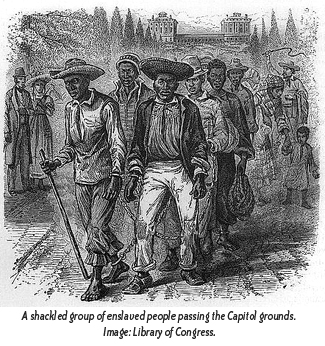
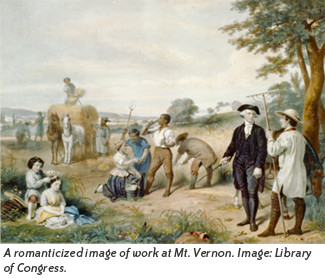 George Washington's stated antislavery convictions misaligned with his actual political behavior. While professing to abhor slavery and hope for its eventual demise, as president Washington took no real steps in that direction and in fact did everything he could to ensure that not one of the more than 300 people he owned could secure their freedom. During the 10 years of construction of the White House, George Washington spent time in Philadelphia where a law called the Gradual Abolition Act passed in 1780. It stated that any slaves brought into the state were eligible to apply for their freedom if they were there for longer than six months. To get around the law, Washington rotated the people working for him in bondage so that they were there for less than six months each.
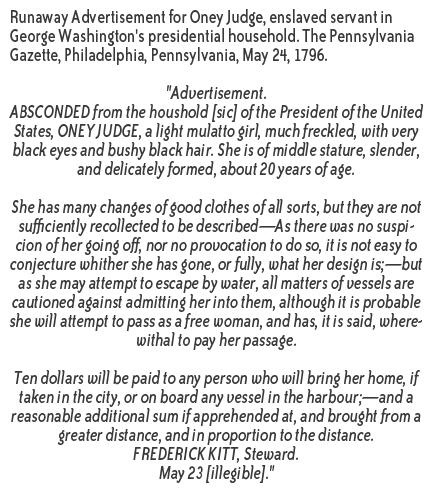 Despite Washington's reluctance to carry out his stated antislavery predilections, the movement against slavery grew anyway, including within the president's very own household among the men and women he enslaved. One of the presidential slaves was Ona "Oney" Maria Judge. In March 1796 (the year before Washington's second term in office ended), Oney was told that she would be given to Martha Washington's granddaughter as a wedding present. Oney carefully planned her escape and slipped out of the Washingtons' home in Philadelphia while the Washingtons were eating dinner. Oney Judge fled the most powerful man in the United States, defied his attempts to trick her back into slavery, and lived out a better life. After her successful attempt became widely known, she was a celebrity of sorts. Her escape from the Washingtons fascinated journalists, writers, and others, but more important, it was an inspiration to the abolition movement and other African Americans who were being enslaved by whites.
 By the age of 10, Paul Jennings was enslaved at the White House as a footman for James Madison, the fourth president of the United States. When he got older, Dolley Madison hired out Jennings, keeping every "last red cent" of his earnings. Dolley indicated in her will that she would give Jennings his freedom, but instead sold him before she died. Thankfully, Daniel Webster intervened and purchased his freedom. Soon after, Paul Jennings helped plan one of the most ambitious and daring efforts to liberate enslaved blacks in U.S. history, thePearl Affair. It was not successful, but as with John Brown's raid, the political repercussions lasted for decades and strengthened the abolitionist cause. Paul Jennings went on to become the first person to write a memoir of a firsthand experience working in the White House.
 Dr. Clarence Lusane is the program director for Comparative and Regional Studies at American University. He teaches courses in comparative race relations, modern social movements, comparative politics of the Americas and Europe, and jazz and international relations. He is a national columnist for the Black Voices syndicated news network.
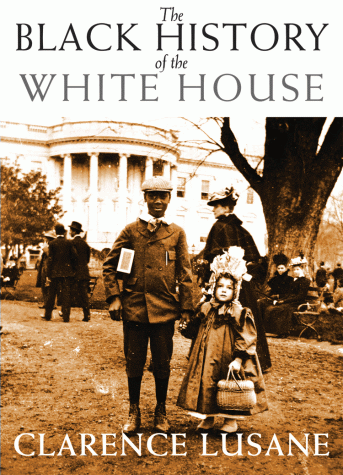 Lusane has authored a number of books including
 The Black History of the White House (City Lights, 2010). This article is part of the Zinn Education Project If We Knew Our History series.


