Showing posts with label ESA. Show all posts

Thursday, November 14, 2013

Mars Flyover


From the highest volcano to the deepest canyon, from impact craters to ancient river beds and lava flows, this showcase of images from ESA’s Mars Express takes you on an unforgettable journey across the Red Planet.
Mars Express was launched on 2 June 2003 and arrived at Mars six-and-a-half months later. It has since orbited the planet nearly 12 500 times, providing scientists with unprecedented images and data collected by its suite of scientific instruments.
The data have been used to create an almost global digital topographic model of the surface, providing a unique visualisation and enabling researchers to acquire new and surprising information about the evolution of the Red Planet.
The images in this movie were taken by the High Resolution Stereo Camera and the video was released by the DLR German Aerospace Center as part of the ten years of Mars Express celebrations in June 2013. The music has been created by Stephan Elgner of DLR’s Mars Express planetary cartography team. DLR developed and is operating the stereo camera.

Thursday, March 14, 2013

Silicon Brains To Oversee Satellites


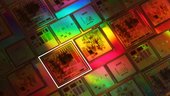
A beautiful and expensive sight: upwards of €6 million-worth of silicon wafers, crammed with the complex integrated circuits that sit at the heart of each and every ESA mission. Years of meticulous design work went into these tiny brains, empowering satellites with intelligence. 
The image shows a collection of six silicon wafers that contain some 14 different chip designs developed by several European companies during the last eight years with ESA’s financial and technical support. 
Each of these 20 cm-diameter wafers contains between 30 and 80 replicas of each chip, each one carrying up to about 10 million transistors or basic circuit switches.
To save money on the high cost of fabrication, various chips designed by different companies and destined for multiple ESA projects are crammed onto the same silicon wafers, etched into place at specialised semiconductor manufacturing  plants or ‘fabs’, in this case LFoundry (formerly Atmel) in France.
Once manufactured, the chips, still on the wafer, are tested. The wafers are then chopped up. They become ready for use when placed inside protective packages – just like standard terrestrial microprocessors – and undergo final quality tests.
Through little metal pins or balls sticking out of their packages these miniature brains are then connected to other circuit elements – such as sensors, actuators, memory or power systems – used across the satellite.
To save the time and money needed to develop complex chips like these, ESA’s Microelectronics section maintains a catalogue of chip designs, known as Intellectual Property (IP) cores, available to European industry through ESA licence. 
Think of these IP cores as the tiniest mission ‘building blocks’: specialised designs to perform particular tasks in space, laid down within a microchip.
These IP cores range from single ‘simpler’ functions such as decoding signals from Earth to control the satellite to highly complex computer tasks such as operating a complete spacecraft.
The latter is achieved for example by the SCOC-3 ‘spacecraft controller on a chip’ developed by ESA and Astrium, which itself combines more than 20 different IP cores from other sources, seen at the bottom of the image.
SCOC3 on silicon wafer
Once manufactured, the chips, still on the wafer, are tested. The wafers are then chopped up. They become ready for use when placed inside protective packages – just like standard terrestrial microprocessors – to undergo final quality tests.
Through little metal pins or balls sticking out of their packages these miniature brains are then connected to other circuit elements – such as sensors, actuators, memory or power systems – used across the satellite.
To save the time and money needed to develop complex chips like these, ESA’s Microelectronics section maintains a catalogue of chip designs, known as Intellectual Property (IP) cores, freely available to European industry.
Think of these IP cores as the tiniest mission ‘building blocks’: specialised designs to perform particular tasks in space, laid down within a microchip.
These IP cores range from single ‘simpler’ functions such as decoding signals from Earth to control the satellite to highly complex computer tasks such as operating a complete spacecraft.
The latter is achieved for example by the SCOC3 ‘spacecraft controller on a chip’ developed by ESA and Astrium, which itself combines more than 20 different IP cores from other sources, seen at the bottom of the image.
Each IP core is coded in a ‘hardware description language’ that can then guide the manufacturing process. Today’s state-of-the-art minimum sizes of integrated circuit tracks are measured in tens of nanometres.
Via: "ESA"

Monday, December 10, 2012

The NASA - ESA InterPlanetary Internet


Astronaut On ISS Uses InterPlanetary Internet To Control Robot In Germany


NASA and the European Space Agency (ESA) used an experimental version of interplanetary Internet in late October to control an educational rover from the International Space Station, NASA says.
The experiment used NASA’s Disruption Tolerant Networking (DTN) protocol to transmit messages and demonstrate technology that one day may enable Internet-like communications with space vehicles and support habitats or infrastructure on another planet.
Space station Expedition 33 commander Sunita Williams in late October used a NASA-developed laptop to remotely drive a small LEGO robot at the European Space Operations Centre in Darmstadt, Germany. The European-led experiment used NASA’s DTN to simulate a scenario in which an astronaut in a vehicle orbiting a planetary body controls a robotic rover on the planet’s surface.
“The demonstration showed the feasibility of using a new communications infrastructure to send commands to a surface robot from an orbiting spacecraft and receive images and data back from the robot,” said Badri Younes, deputy associate administrator for space communications and navigation at NASA Headquarters. “The experimental DTN we’ve tested from the space station may one day be used by humans on a spacecraft in orbit around Mars to operate robots on the surface, or from Earth using orbiting satellites as relay stations.”
The DTN architecture is a new communications technology that enables standardized communications similar to the Internet to function over long distances and through time delays associated with on-orbit or deep space spacecraft or robotic systems. The core of the DTN suite is the Bundle Protocol (BP), which is roughly equivalent to the Internet Protocol (IP) that serves as the core of the Internet on Earth.
While IP assumes a continuous end-to-end data path exists between the user and a remote space system, DTN accounts for disconnections and errors. In DTN, data move through the network “hop-by-hop.” While waiting for the next link to become connected, bundles are temporarily stored and then forwarded to the next node when the link becomes available.
NASA’s work on DTN is part of the agency’s Space Communication and Navigation (SCaN) Program. SCaN coordinates multiple space communications networks and network support functions to regulate, maintain and grow NASA’s space communications and navigation capabilities in support of the agency’s space missions.